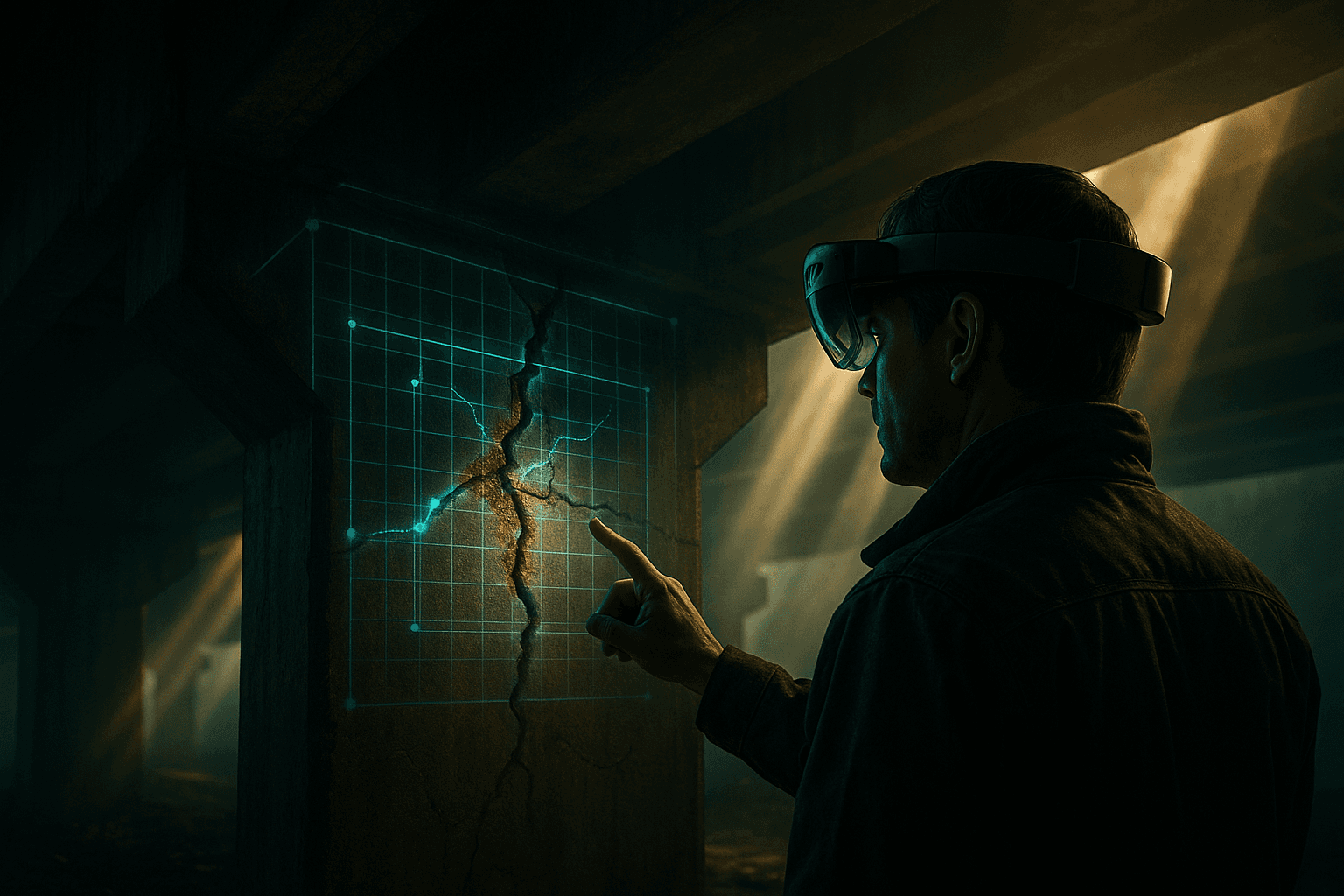
AR headsets can overlay damage data on real bridges during inspections, but field evidence remains limited to small pilots.
Civil structures like bridges age and develop cracks, spalling, or corrosion over time. Inspectors traditionally use clipboards, photos, and memory to track these issues. Extended reality (XR) technologies—including augmented reality (AR), virtual reality (VR), and mixed reality (MR)—allow inspectors to see digital models or AI-flagged damage directly overlaid on the physical structure in real time. A 2022 literature review of 43 studies found XR mostly used for visualization and remote collaboration, not everyday field work. Recent small-scale bridge tests show measurement errors under 10 percent in controlled settings, but broad real-world data on large projects is still missing.
Most published work addresses design and training, not ongoing condition assessment.
Systematic reviews of XR in construction from 2019–2024 show the main uses are in pre-construction visualization and safety training. Condition assessment makes up a smaller portion. The 2022 Sensors review noted 29 AR/MR studies versus 16 VR studies on inspection tasks like crack mapping or remote expert help. Later single-site tests from 2024–2025 combine MR headsets with AI to spot cracks, rust, and spalling on actual bridges, but these are still early proof-of-concept trials.
Measurement accuracy in pilots reaches practical levels for visual inspection.
One XR system measured damage areas on a real concrete bridge with errors below 10 percent when inspectors fine-tuned AI suggestions. Another AR setup achieved under 2 percent error on distances up to six meters. These results come from small tests on easy-to-reach structures; performance on tall, tight, or busy sites remains untested at scale.
Collaboration improves when remote experts view the same live scene.
5G-enabled AR and multi-user MR/VR platforms let on-site and off-site teams mark up the same 3D model together. Field trials on full-scale bridges showed quicker data sharing than phone photos or video calls, though spotty networks and heavy headsets still limit use.
Barriers center on integration and cost rather than core technology.
Reviews highlight gaps in linking building information models (BIM) to XR, high headset prices, and missing standard ways to label damage. No large randomized studies yet compare XR-assisted inspections against traditional methods for safety or long-term maintenance savings.
XR works by anchoring digital layers to physical coordinates so inspectors see both at once.
Imagine a transparent map overlay that shifts as you move your head. The headset tracks its position, aligns with the structure’s digital twin or camera view, and places AI highlights or notes exactly on the damage. This cuts the mental effort of switching between photos and the real beam or deck.
Start with a smartphone AR viewer before buying hardware.
Option 1: Try a free BIM viewer app that supports AR (many handle glTF or IFC models) and load a public bridge model on your phone. Walk around a small structure to test alignment. Option 2: If your team uses Autodesk or Bentley software, test its built-in AR export on one inspection. Option 3: For groups, request a short vendor demo of HoloLens-style gear. All need an existing 3D model—without one, benefits drop sharply.
Common misreads include expecting lab accuracy on every structure and assuming immediate cost savings.
Pilots often use prepared sites and pre-aligned models. Real drift, bad lighting, or missing BIM data hurt results. Headset fatigue after two hours and model update needs add hidden costs. XR helps most for repeated visual checks where models already exist; it adds little for one-time surveys of simple assets.
Try one model overlay on a single accessible element for 30–60 minutes this week.
Pick a footbridge or retaining wall with an available IFC or Revit file. Load it in an AR viewer, walk the site, and note any clear misalignment or helpful damage markers. Stop if alignment error exceeds 5 cm or setup takes over an hour. Revisit only after confirming a repeatable process or budgeting for suitable hardware based on your inspection needs.
Sources
Catbas FN et al. Extended Reality (XR) for Condition Assessment of Civil Engineering Structures: A Literature Review. Sensors. 2022 (43 studies reviewed; primary source for inspection focus). Gornall J et al. Extended Reality in Construction 4.0: A Systematic Review. Applied Sciences. 2025 (76 articles, 2019–2024; maps application areas and barriers). Recent pilots include Virginia Transportation Research Council MR+AI bridge work (2025), 5G AR drone frameworks (2024), and MR AI bridge inspection studies (2025). All single-structure or lab-scale tests.