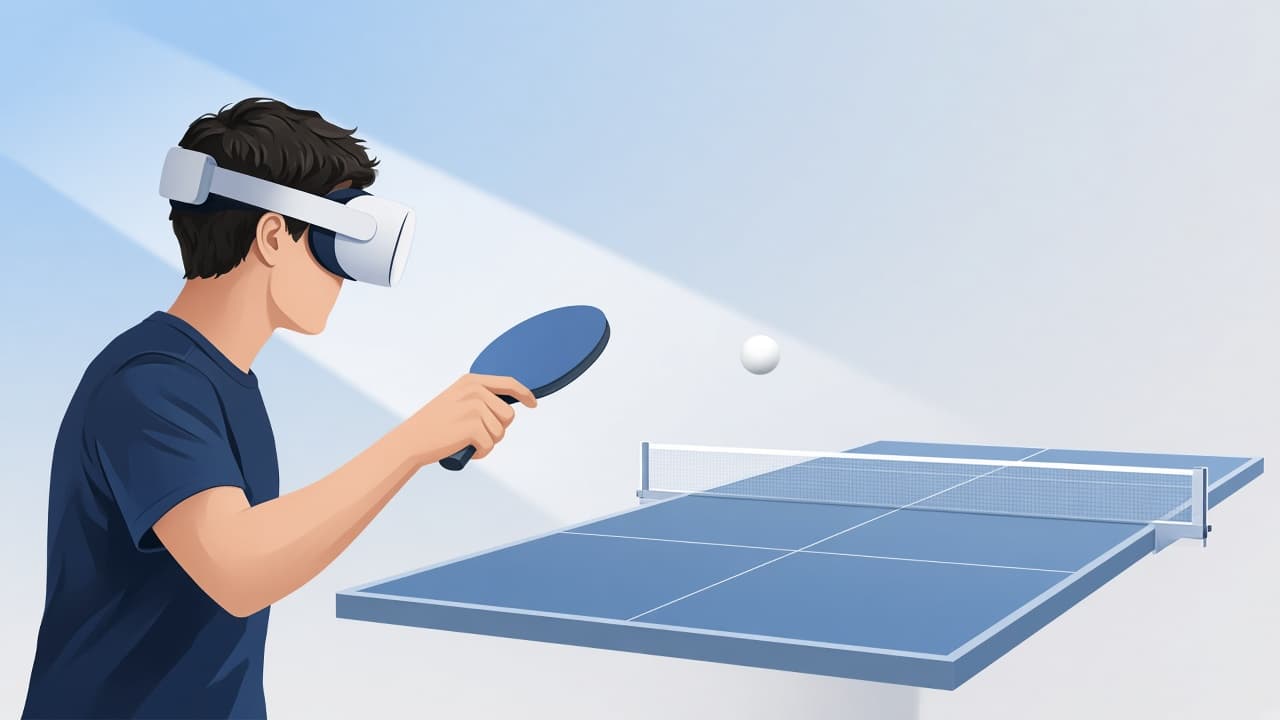
When a table-tennis rally ends quickly, it can be hard to decide what to practise next. Should you work on getting the ball back onto the table, or begin aiming your returns more deliberately? A short VR session can give you something concrete to reflect on: what happened when you tried each task.
This proposed exercise uses Eleven Table Tennis's AI opponent for two small blocks of play. First, concentrate on landing returns anywhere on the opponent's side. Then choose a broad area to aim at. Finish by writing one focus for your next session, supported by an observation you actually made.
What the VR part contributes
Eleven is a table-tennis simulation with single-player AI play. Its developer lists single-player and training modes, while the game's store descriptions document matches against an AI opponent and tracked-controller support. The developer's feature overview and Steam listing describe those capabilities.
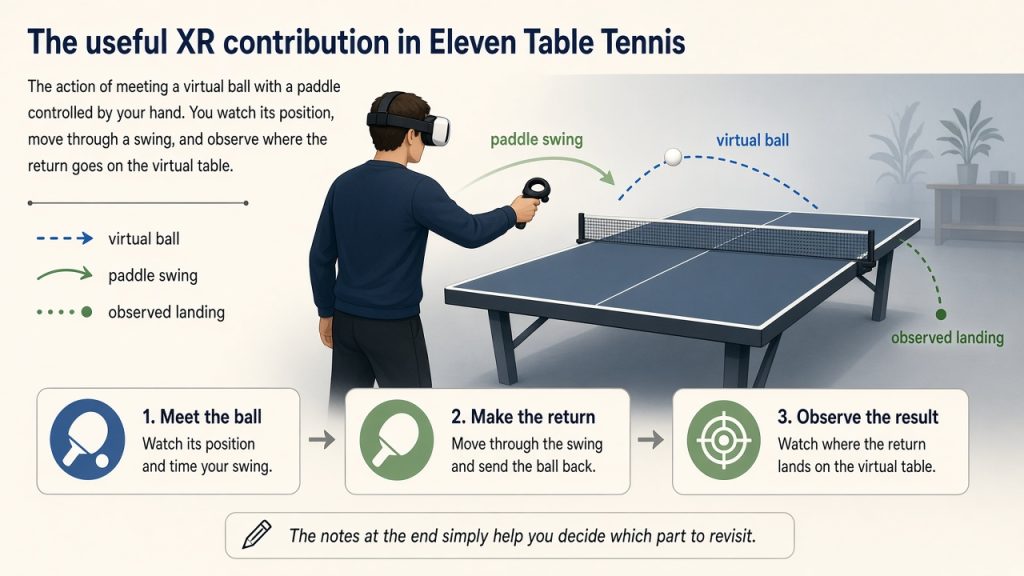
The useful XR contribution is the action of meeting a virtual ball with a paddle controlled by your hand. You watch its position, move through a swing, and observe where the return goes on the virtual table. That makes timing and placement something you can attempt during play. The notes at the end simply help you decide which part to revisit.
Choose the right setup
This plan uses the native Meta Quest edition, a compatible Quest headset, and Touch controllers. Eleven is a paid app; check the current price and your headset's compatibility on the official Quest listing before buying. That listing specifically supports practising against AI, so the exercise does not depend on finding an online partner.
Clear enough space to make a comfortable paddle swing without hitting furniture or another person. Follow your headset's boundary and controller-safety instructions. The virtual table cannot support your weight, so keep your balance without leaning on it.
Have a small piece of paper ready outside the play area. Give it two headings: Returns onto the table and Returns toward my chosen half. The counts below are a suggested way to observe your play; they are not a built-in Eleven assessment or an automatic coaching feature.
1. Settle into solo play
Open Eleven and choose single-player play against the AI. Take a few uncounted rallies to get comfortable with the paddle and table. The aim is a manageable exchange in which you can follow the ball. Keep the same opponent and setup for both blocks.
Use one consistent observation rule: count only your first return opportunity in each rally. Your own serve is not a return attempt. If a rally ends before an incoming ball bounces on your side of the table, skip it. Once that ball arrives, missing it counts as an unsuccessful attempt, even if it was difficult to reach.
Concentrating on that one moment keeps the exercise manageable. Let the rest of the rally play out, then remember what happened to the first return. You are not trying to record every stroke while playing.
2. Observe five ordinary returns
For five return opportunities, aim simply to send the ball over the net and onto the opponent's side. Count how many of those first returns land there. If an attempt fails, notice whether you missed the ball, hit the net, or sent it beyond the table.
After the fifth opportunity, stop playing, remove the headset, and write the count under the first heading. Add one brief observation, such as "Several went long" or "I often missed the incoming ball." If you lost count or could not judge a landing, write that uncertainty instead of guessing.
3. Try a broad placement target
Return to the same solo setup. Mentally divide the opponent's side of the table into left and right halves, as seen from your position. Choose one half and keep that target for this block. A broad half is easier to judge than an imagined small corner.
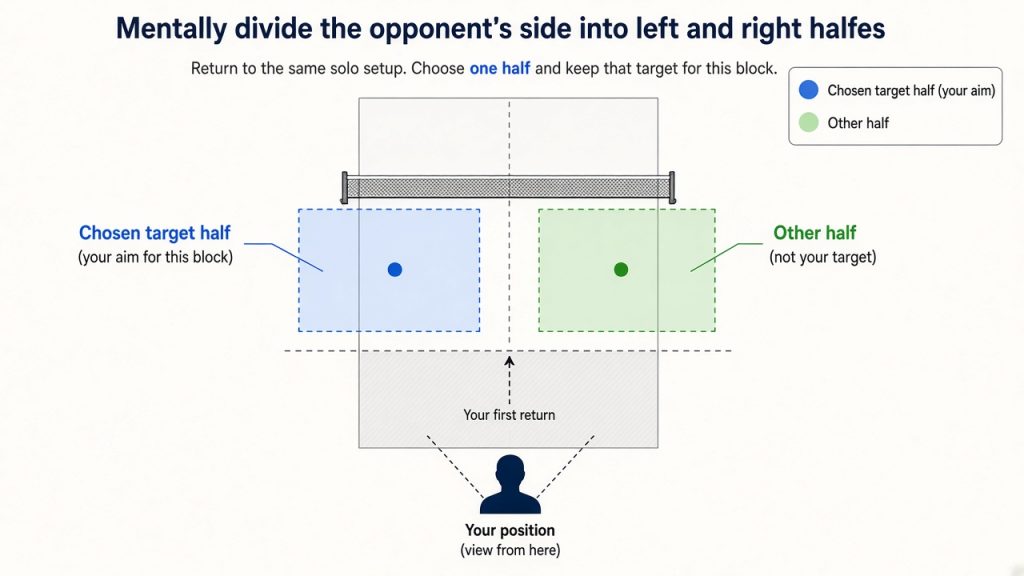
Observe five more first-return attempts. For each, notice whether the ball lands in your chosen half, elsewhere on the opponent's side, or fails to land on the table. Count only the chosen-half landings toward this block's target. There is no need to hit harder; the added task is deciding where to send the return.
Stop and write down the target, your count, and a short observation. For example: "Aimed left; two of five landed there; several other returns stayed on the table." This is an example of a note, not a reported test result.
4. Pick one focus for next time
Read the two notes together. If making contact or keeping the return on the table occupied most of your attention, make that your next session's focus. If ordinary returns felt manageable but the chosen direction was difficult, focus on placing a gentle return into that same broad half.
Write one sentence that joins a next action to your observation: "Next time I will work on keeping returns on the table, because several of today's first attempts went long." Or: "Next time I will keep aiming left, because my returns landed on the table but often went to the other half."
The two counts describe different tasks and different incoming balls. They are not a controlled comparison or a reliable skill rating, and they do not establish how you will perform at a physical table. Treat them as a small snapshot of this VR session. If both blocks were confusing, choosing an easier, uncounted familiarisation session is a useful outcome too.
Finish with that one written focus. The purpose of this session is to replace a vague intention to "get better" with a specific thing to try when you next pick up the virtual paddle.
This is an author-proposed exercise based on Eleven's published product information, checked November 25, 2026. We have not hands-on tested this particular exercise.