2026-06-19 21:00:00
Table of Contents
Discover Surgical Theater’s eXperiential Reality: Revolutionizing Surgical Precision with XR
Master Patient-Specific Surgical Rehearsal for Complex Procedures
Enhance Intraoperative Guidance with Real-Time AR Overlays
Transform Patient Consultations Through Immersive 3D Visualization
Unifying XR Across the Surgical Continuum for Broader Impact
Adopt Surgical Theater XR: A Practical Implementation Roadmap
Essential Insights from Surgical Theater’s XR Innovations
Transparency and Forward-Looking Notes on XR in Medicine
Master Patient-Specific Surgical Rehearsal for Complex Procedures
Enhance Intraoperative Guidance with Real-Time AR Overlays
Transform Patient Consultations Through Immersive 3D Visualization
Unifying XR Across the Surgical Continuum for Broader Impact
Adopt Surgical Theater XR: A Practical Implementation Roadmap
Essential Insights from Surgical Theater’s XR Innovations
Transparency and Forward-Looking Notes on XR in Medicine
Discover Surgical Theater’s eXperiential Reality: Revolutionizing Surgical Precision with XR
Surgical Theater, founded in 2010 and headquartered in Cleveland, Ohio, with backing from partners like Siemens Healthineers, develops pioneering XR platforms that convert standard 2D medical scans into interactive 3D models. Its eXperiential Reality® (XR) technology improves surgical outcomes, patient understanding, and clinical efficiency by leveraging immersion and spatial computing to bridge the gap between imaging and real-world execution. Recent milestones include surpassing 50,000 XR utilizations by late 2025 across spine, cranial, and other specialties, with measurable benefits like modified surgical plans in 24% of cases and enhanced patient retention. This innovative service addresses three key areas: patient-specific preoperative rehearsal, real-time intraoperative AR guidance, and enhanced patient consultations for better-informed decisions. Surgical Theater’s eXperiential Reality stands out for its verifiable clinical impact in healthcare.
Master Patient-Specific Surgical Rehearsal for Complex Procedures
Surgical Theater’s PlanXR™ tool converts patient MRI, CT, and DTI scans into immersive VR reconstructions, allowing surgeons to rehearse procedures on exact anatomy replicas before entering the OR. For neurosurgery or spine cases, this means flying through 3D models to identify tumors or aneurysms from all angles, refining approaches that reduce operative time by up to 29% in aneurysm clipping and minimize clip attempts. It leverages XR’s spatial computing strengths for hands-on interactivity unavailable in 2D imaging, with studies showing 24% of plans modified after VR review. Challenges include initial learning curves for integration with existing workflows and data privacy in AI-driven modeling, but edge cases like complex multi-organ involvement benefit most. Measurable outcomes include 100% patient satisfaction improvements and 90.6% surgery enrollment rates post-visualization, directly supporting precision in regenerative medicine-adjacent fields like tissue repair surgeries.
Enhance Intraoperative Guidance with Real-Time AR Overlays
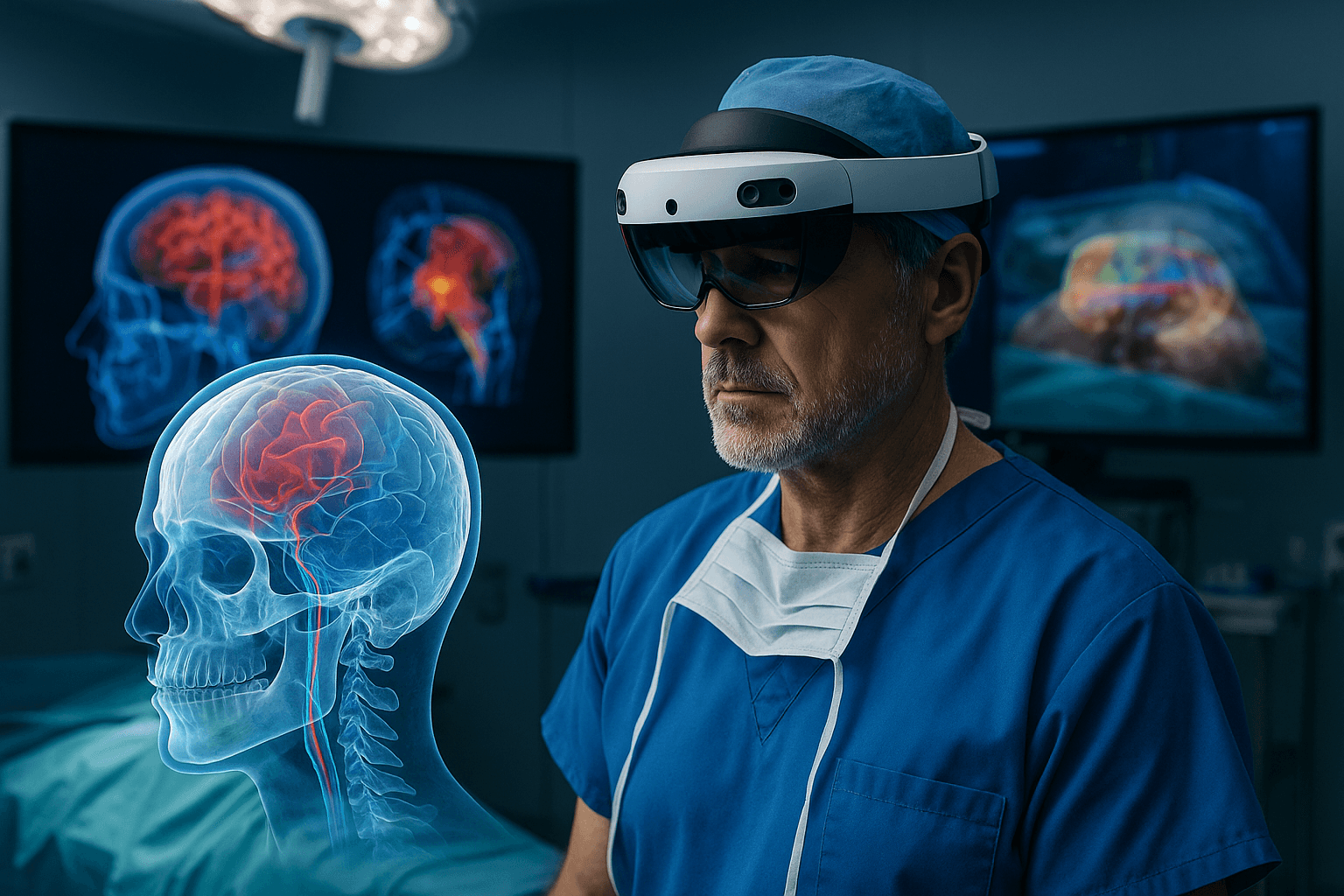
SyncAR® Spine and similar AR modules overlay the pre-planned 3D XR model directly onto the patient in the operating room, providing live, interactive visualization that feels like open surgery even in minimally invasive settings. Surgeons navigate tools and DICOM images seamlessly within the AR environment, improving precision during spine or cranial procedures without increasing complexity. This harnesses XR interactivity and immersion to deliver real-time spatial alignment, with clinical data indicating fewer complications and reduced total operative time. Potential challenges involve hardware calibration in sterile fields or adaptation for varying OR lighting, yet it excels in high-stakes scenarios like aneurysm repairs. Benefits include documented efficiency gains, such as 29% faster clip placement, fostering safer outcomes and scalability across specialties with growing adoption evidenced by 50,000+ utilizations.
Transform Patient Consultations Through Immersive 3D Visualization
During clinic visits, eXperiential Reality enables patients to explore their own personalized 3D anatomical models in VR or AR, fostering deeper understanding of conditions and proposed interventions in tissue engineering or regenerative contexts. Examples include visualizing aneurysm locations or spinal issues, leading to 50% higher retention and 89% reduced outmigration as patients feel more empowered. It exploits XR’s empathetic immersion to build trust and clarity beyond static images or verbal explanations, with 100% reporting improved satisfaction. Edge cases like pediatric or anxious patients may require guided sessions, but logical implications include better compliance and informed consent. Supporting feedback from real-world use highlights transformative shifts in patient engagement, directly tying into broader healthcare accessibility.
Unifying XR Across the Surgical Continuum for Broader Impact
The three use cases interconnect seamlessly: preoperative rehearsal informs intraoperative AR execution, while both enhance consultation-driven patient buy-in, creating a cohesive ecosystem that boosts overall productivity and empathy in surgical care. This synergy enables long-term scalability from individual hospitals to global networks, potentially accelerating innovations in regenerative medicine by improving precision in complex tissue-related procedures. Trade-offs include upfront hardware investments offset by efficiency gains, complemented by AI advancements for even more accurate modeling. Collectively, it drives societal progress toward safer, more accessible healthcare with reduced errors and higher satisfaction across personal and professional contexts.
Adopt Surgical Theater XR: A Practical Implementation Roadmap
1. Assess compatibility by contacting Surgical Theater via their site for a demo, ensuring your facility has compatible hardware like Microsoft HoloLens or VR headsets (typical setup costs start in the mid-five figures depending on scale). 2. Begin with a pilot in one specialty, such as neurosurgery, integrating with existing PACS systems for seamless DICOM import—leverage their training resources for staff onboarding in 1-2 weeks. 3. Start gradual adoption with consultation use cases for beginners before advancing to full OR deployment, monitoring metrics like plan modifications. 4. Budget for annual licensing and maintenance while exploring partnerships for subsidized access in academic or underserved settings. Overcome barriers like tech resistance through phased training and data on proven outcomes; resources include case studies on their website.
Essential Insights from Surgical Theater’s XR Innovations
- XR rehearsal modifies 24% of surgical plans, directly improving precision and patient safety.
- 50,000+ utilizations by 2025 prove real-world scalability with measurable efficiency gains like 29% time reductions.
- Patient satisfaction reaches 100% when using immersive 3D models, enhancing informed consent and retention.
- AR overlays bridge planning to execution, reducing complications in complex cases without added complexity.
- Integration with AI for 3D reconstruction positions this as a foundational tool for future regenerative surgery advancements.
- Gradual adoption strategies make XR accessible, yielding high ROI through better outcomes and workflow optimization.
Transparency and Forward-Looking Notes on XR in Medicine
This post was generated with AI assistance using Grok/xAI tools, synthesizing information from publicly available sources such as company announcements and industry reports (primarily 2025-2026). Readers should independently verify all technical claims, clinical data, and regulatory status, exercising discretion on health, safety, or investment matters. XR technology in medicine evolves rapidly, with ongoing advancements in hardware and AI promising even greater integration; perspectives here emphasize evidence-based optimism balanced by practical considerations.