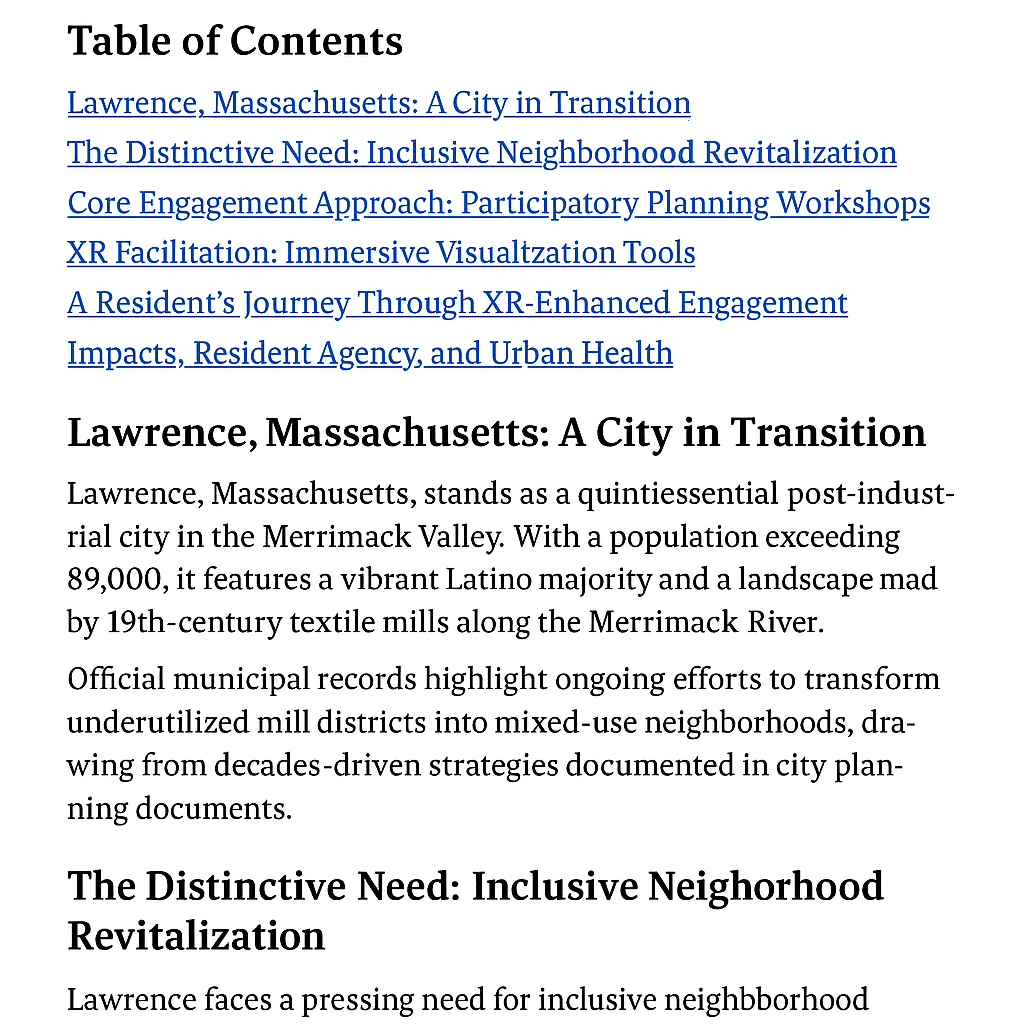
Table of Contents
Lawrence, Massachusetts: A City in Transition
The Distinctive Need: Inclusive Neighborhood Revitalization
Core Engagement Approach: Participatory Planning Workshops
XR Facilitation: Immersive Visualization Tools
Lawrence, Massachusetts: A City in Transition
Lawrence, Massachusetts, stands as a quintessential post-industrial city in the Merrimack Valley. With a population exceeding 89,000, it features a vibrant Latino majority and a landscape shaped by 19th-century textile mills along the Merrimack River.
Official municipal records highlight ongoing efforts to transform underutilized mill districts into mixed-use neighborhoods. These initiatives draw from decades of community-driven strategies documented in city planning documents.
The Distinctive Need: Inclusive Neighborhood Revitalization
Lawrence faces a pressing need for inclusive neighborhood revitalization in its former industrial zones. Decades of disinvestment left many mill buildings vacant, while rapid demographic shifts created demand for equitable development that serves long-time residents rather than displacing them.
City reports and studies, including those tied to the Reviviendo Gateway Initiative, emphasize bridging gaps between diverse communities and redevelopment plans. This quality distinguishes Lawrence among New England cities grappling with similar legacies.
Core Engagement Approach: Participatory Planning Workshops
Participatory planning workshops serve as the primary engagement approach. These structured sessions bring residents, city officials, developers, and nonprofits together to co-create visions for specific sites.
Workshops typically involve mapping exercises, feedback on proposals, and iterative discussions. They build on established practices in Lawrence’s community development framework, ensuring local voices shape outcomes from the outset.
XR Facilitation: Immersive Visualization Tools
Extended Reality technologies, particularly augmented and virtual reality applications, transform these workshops. Participants don lightweight AR headsets or use tablet-based apps to overlay proposed building designs, green spaces, and pedestrian pathways onto existing street views in real time.
XR allows residents to “walk through” future neighborhoods, adjusting elements like building heights or park layouts on the spot. This shifts abstract blueprints into tangible experiences, deepening understanding and feedback quality during participatory sessions.
A Resident’s Journey Through XR-Enhanced Engagement
Maria Gonzalez, a longtime Lawrence resident and parent, attends a workshop focused on the former Arlington Mills complex. In the past, she struggled to interpret 2D renderings; now, an XR app lets her stand on the sidewalk and see a proposed affordable housing building integrated with a community garden.
She adjusts the virtual model to include more family-oriented amenities, then shares her changes with neighbors via a shared digital session. The tool records her input alongside others, creating a living document that evolves throughout the evening.
Over multiple workshops, Maria notices how XR reveals hidden issues, such as sunlight patterns on new plazas or accessibility routes. Her suggestions influence final designs, fostering a sense of ownership she had not experienced in earlier planning efforts.
Impacts, Resident Agency, and Urban Health
XR-enhanced participatory planning in Lawrence yields concrete results: higher attendance at workshops, more diverse input, and redevelopment plans that better reflect community priorities like affordable units and cultural spaces. Residents report greater trust in city processes.
This approach strengthens resident agency by democratizing visualization and decision-making. It moves engagement beyond token consultation toward genuine co-creation, particularly for historically underrepresented groups.
Broadly, such methods contribute to urban health by building social cohesion, reducing displacement risks, and creating environments that support physical activity and mental well-being. Lawrence’s example illustrates how targeted XR integration can revitalize civic life in mid-sized American cities facing similar transitions.