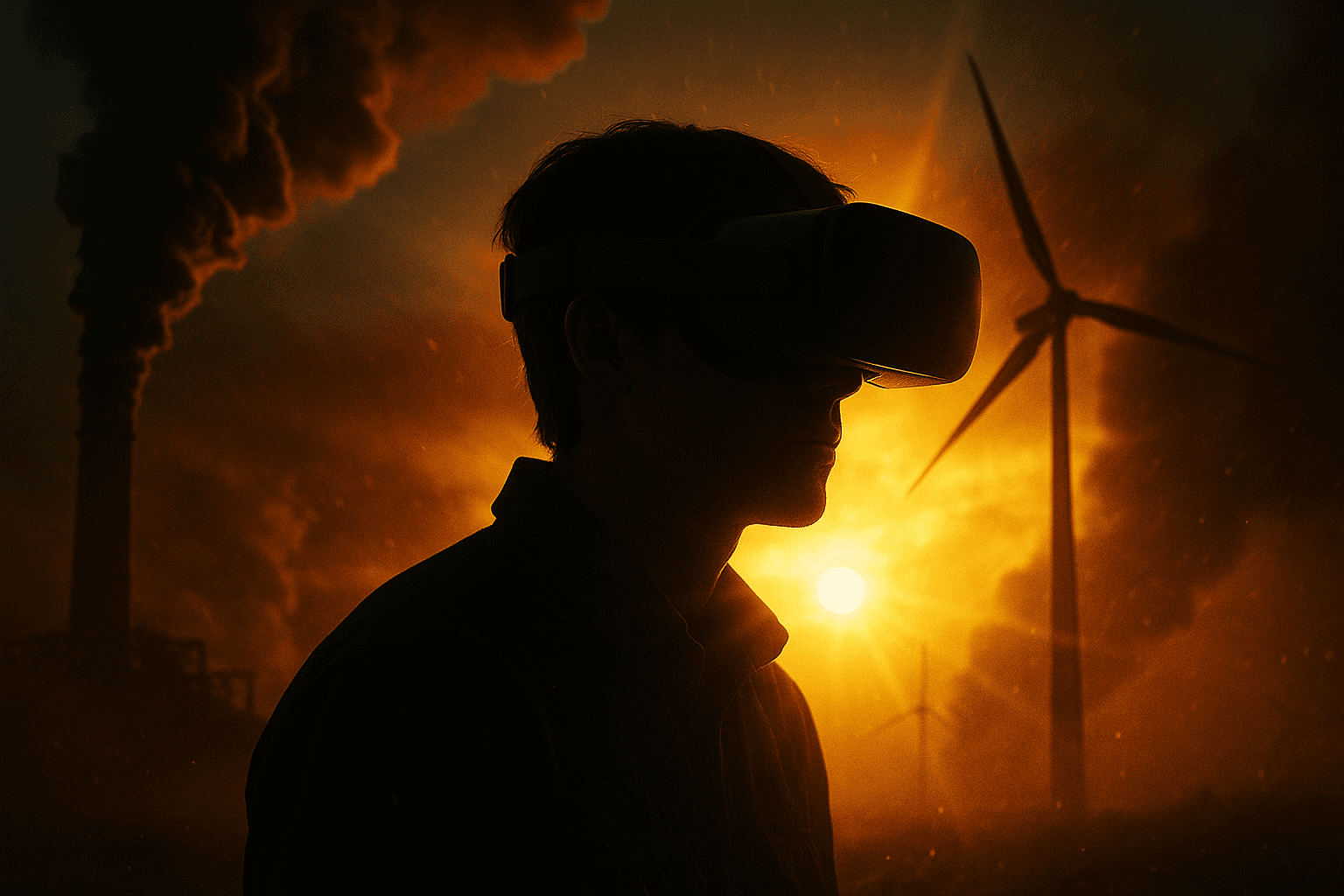
Imagine a world where economic headwinds and political shifts force climate tech to go "quiet," yet innovation surges beneath the surface. In 2026, as detailed in this Forbes analysis, the sector is pivoting from bold proclamations to pragmatic, efficiency-driven models. Last year saw challenges like rolled-back net-zero pledges and a perception of slowdown, but data tells a different story: 92% of new global electricity capacity came from wind and solar, EV sales hit over 25% of new vehicles, and battery deployment skyrocketed to 300 GWh. Companies are rebranding efforts around cost savings and resilience, with about 60% scaling back external climate talks amid fears of scrutiny— a phenomenon known as "greenhushing," explored in this report. Yet, as climate impacts intensify, demand for adaptive solutions grows. Enter extended reality (XR) technologies, which bridge this quiet revolution by enhancing manufacturing processes and societal integration of AI. XR offers immersive simulations for sustainable production, allowing firms to test eco-friendly designs without real-world waste, while AI-XR tools democratize climate education, fostering proactive community responses. This post explores these connections, unpacking how XR can turn 2026's strategic shifts into actionable advantages. We'll delve into problem analyses, XR applications in manufacturing, societal AI integration, ethical considerations, and forward steps, equipping you with insights to navigate this evolving landscape affordably and effectively.
Table of Contents
Understanding the 2026 Climate Tech Shift
The climate tech landscape in 2026 reflects a maturation process, where overt environmental advocacy gives way to embedded economic incentives. As political volatilities, such as funding cuts, prompt rebranding, innovators focus on unit economics that undercut legacy systems. For instance, technologies like hydrogen-electric propulsion are advancing through demonstrated pilots, emphasizing performance over ideology. This shift, while subtle, accelerates adoption in renewables and EVs, driven by cost-effectiveness rather than mandates.
Amid these changes, greenhushing emerges as a coping mechanism, with 58% of organizations citing lack of progress as a reason for reduced communications. Drawing from sector analyses, this trend highlights the need for verifiable progress tracking, particularly in Scope 3 emissions, which often remain unaddressed in decarbonization efforts.
"Climate change isn’t a challenge that will vanish. As it affects our day-to-day lives, demand for solutions that explicitly reduce emissions or help communities adapt will skyrocket." – Juliette Devillard, founder of Climate Connection
XR in Sustainable Manufacturing
Extended reality technologies intersect with climate tech by revolutionizing manufacturing processes, enabling virtual prototyping that minimizes material waste and energy use. In a hypothetical scenario, a factory engineer uses XR headsets to simulate production lines optimized for low-emission materials, identifying inefficiencies before physical implementation. This AI-XR integration not only cuts costs but aligns with 2026's emphasis on efficiency-driven sustainability.
Consider the data: battery storage deployment jumped from 9 GWh in 2020 to 300 GWh in 2025, per industry reports. XR can enhance this by training workers on advanced assembly techniques in immersive environments, reducing errors and accelerating adoption of green tech.
| Manufacturing Aspect | Traditional Method | AI-XR Enhanced |
|---|---|---|
| Prototyping | Physical models, high waste | Virtual simulations, zero waste |
| Training | On-site, time-intensive | Immersive, scalable |
| Efficiency Gains | 10-20% optimization | Up to 40% with AI analytics |
Such applications draw from ventures like those at Voyager VC, which highlight breakneck growth in energy transitions.
Integrating AI via XR for Societal Adaptation
Beyond manufacturing, XR facilitates AI's integration into society by creating accessible platforms for climate awareness and adaptation. Picture community workshops where participants don XR devices to experience simulated flood scenarios, powered by AI predictions, fostering empathy and preparedness without real risks.
This approach addresses greenhushing by enabling transparent, data-backed education. With 81% of companies noting competitive edges from net-zero communication, XR tools can amplify this by visualizing progress, such as emission reductions in supply chains, as discussed in analyses of Scope 3 emissions monitoring.
- AI algorithms process vast datasets for accurate climate models.
- XR immerses users in future scenarios, encouraging behavioral shifts.
- Combined, they empower affordable, proactive community actions.
Ethical and Practical Considerations
While promising, AI-XR applications in climate tech raise ethical questions, such as data privacy in immersive simulations or equitable access to these tools. In edge cases, over-reliance on virtual models might overlook real-world variables, potentially leading to misguided strategies.
Balancing pros and cons, XR's affordability—devices now under $500—makes it viable for widespread use, but implementation must prioritize inclusivity to avoid exacerbating digital divides. Expert insights from firms like Green Lark emphasize starting with bottom-line benefits to ensure ethical alignment.
Pathways to Implementation
- Assess current processes: Identify manufacturing bottlenecks using tools from Kempower for energy insights.
- Integrate XR prototypes: Test AI-driven simulations for sustainable tweaks.
- Scale societal programs: Launch community XR sessions on climate adaptation.
- Monitor and iterate: Use verified labels, as in South Pole initiatives, for credible tracking.
These steps transform 2026's quiet strategies into tangible impacts.
Key Takeaways
- 2026 climate tech focuses on quiet, efficiency-driven innovation amid greenhushing, with 92% new electricity from renewables.
- AI-XR enhances manufacturing by enabling waste-free virtual prototyping and training.
- XR integrates AI into society through immersive climate education, addressing adaptation needs.
- Ethical use requires balancing access and privacy to maximize benefits.
- Implementation pathways include assessment, prototyping, scaling, and monitoring for proactive sustainability.
- Data shows EV charger energy delivery up 96% in 2025, underscoring transition momentum.
- Repositioning climate efforts around economics builds resilience against political shifts.
As we navigate 2026's climate tech evolution, the fusion of XR with these strategies offers a pathway to intuitive, effective solutions. By simulating sustainable manufacturing and fostering societal AI integration, XR not only addresses immediate challenges but paves the way for long-term resilience. Consider how a factory might redesign processes virtually to cut emissions, or communities could prepare for extreme weather through AI-powered immersions—these aren't distant futures but accessible tools today. The broader implication? In an era of quiet climate action, XR amplifies impact without fanfare, empowering individuals and businesses to contribute meaningfully. What next? Start by exploring XR demos for personal or professional use, or join discussions on platforms like those from Climate Connection. Share this post to spark conversations, comment on your XR experiences, or trial free AI-XR apps for climate modeling. Together, these steps bridge curiosity to action, turning 2026's uncertainties into opportunities for a cooler planet.
What are your thoughts? Comment below!
Generated by AI. Reviewed by Human.