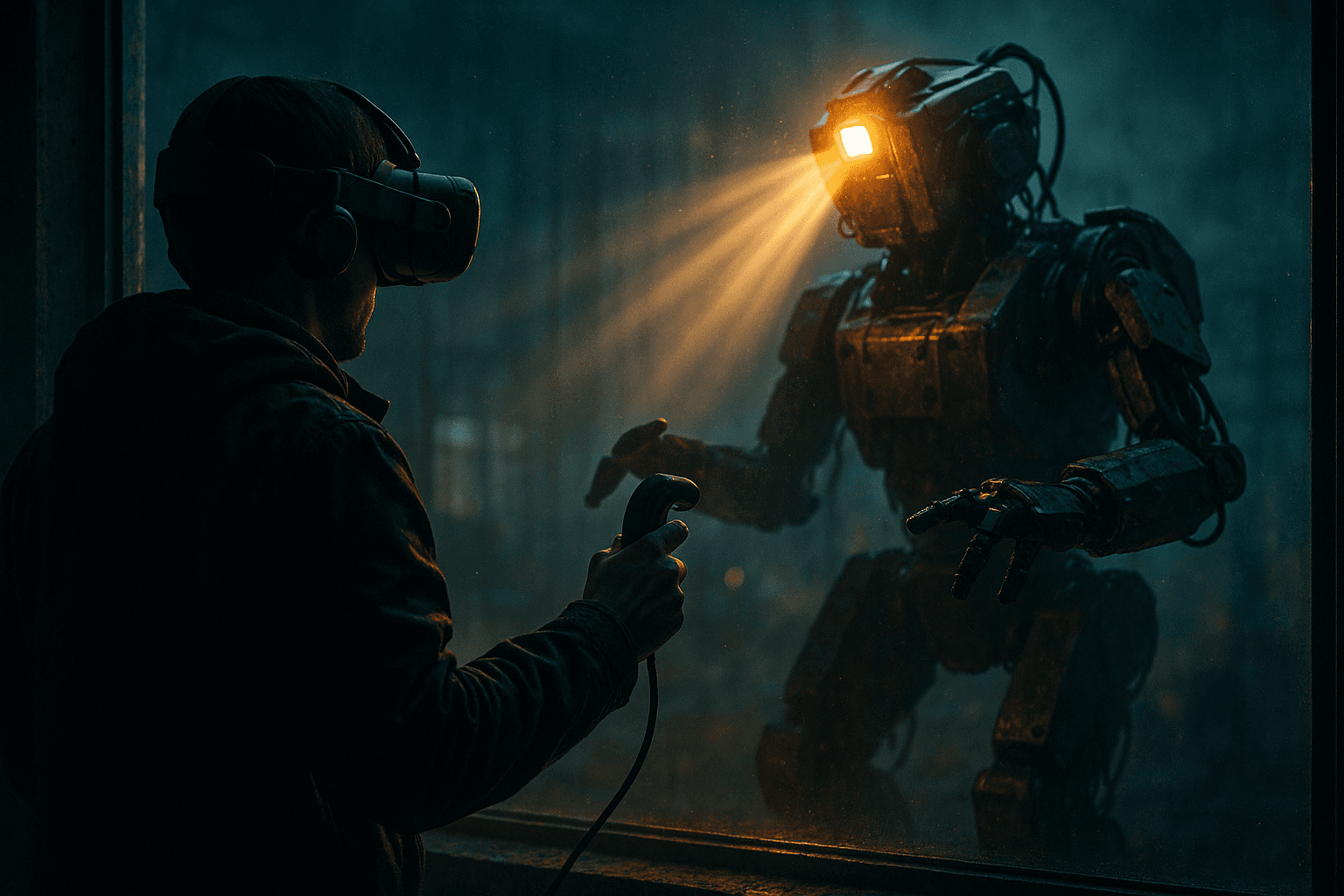
Remote places too dangerous or hard for people to reach now let human operators guide robots using extended-reality headsets instead of flat video screens. A 2024 review of 100 studies found that XR headsets (virtual, augmented, or mixed reality) help operators finish tasks faster and with fewer mistakes than traditional screens and joysticks, especially in complicated scenes.
XR headsets lower mental effort when steering robots from afar
Operators wearing VR or MR headsets see robot camera views with helpful 3-D overlays. They complete handling tasks quicker than people using monitor-and-joystick setups, particularly when they must switch camera angles or the remote area is complex. See the full review here.
Strongest proof comes from lab tests, not real sites yet
Nearly all 100 studies happened indoors or in simulations with short tasks lasting minutes to hours. Outdoor or underwater tests show smaller improvements and more problems from lost tracking or internet delays.
Digital copies of the site help connect what you see to what the robot does
Many setups build a 3-D model of the remote place that updates live. The operator moves a virtual version, and the real robot copies those moves. This works best when internet delay stays under about 500 milliseconds and the scene does not change fast. Read more on digital twins in the paper.
Hand controllers remain the top way to give commands
Built-in VR controllers appeared most often across the studies. Newer hand tracking and haptic gloves need extra setup and work less reliably outside labs.
Think of XR as a clear window into a distant place, not instant magic
Picture standing in a room whose walls show a live 3-D model of a faraway worksite. When you reach out, the model moves and the real robot follows. The view adds depth that flat video misses, but it still needs good cameras, light, and steady internet on the other end.
Begin with free demos on phones or affordable headsets
Anyone with a recent smartphone or a Meta Quest headset can try public XR robot demos built in Unity or ROS tools. Load a free digital-twin example and practice simple pick-and-place moves in one afternoon.
Test your internet delay before scaling up
Next, link the headset to a low-cost robot arm or online simulator and check round-trip delay. If it often exceeds 500 milliseconds, start with regular video instead of pushing XR.
Overly perfect 3-D models often fail in messy real conditions
Lab papers assume perfect lighting and slow changes. In dusty, moving, or dim sites, tracking breaks and the virtual model drifts, forcing operators back to raw camera views.
High-speed internet needs rule out many field spots
Trials on 5G or fiber connections show clear gains. Standard 4G or satellite links often drop frames and frustrate users. Always check your actual connection first.
Try one free XR robot demo for under an hour this week
Search for Unity XR robotics examples or ROS web viewers. Success means finishing a few simple pick-and-place cycles without the model drifting. Switch to video if tracking fails often or motion sickness appears.
Sources
Systematic review by Wang, Shen, and Lee (arXiv:2403.11384, 2024; later in ACM Computing Surveys). Most cited work involves small lab tests; large real-world trials remain rare.