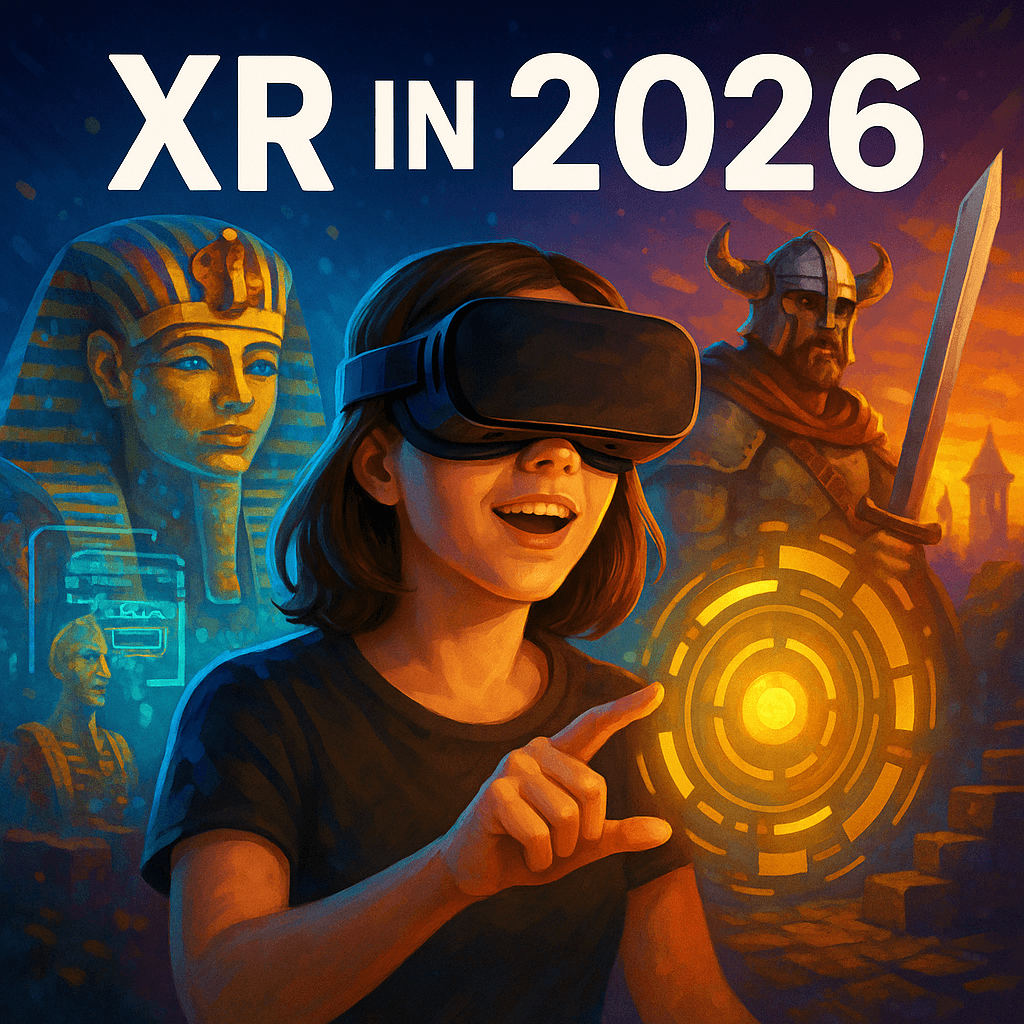
Imagine stepping into a museum where ancient artifacts come alive with digital overlays, or mastering complex skills through immersive games that feel like play. In 2026, extended reality (XR) is transforming how we interact with the world, blending the physical and digital seamlessly. A groundbreaking scoping review on Spatial Augmented Reality (SAR) in cultural heritage reveals how this technology projects digital content onto real objects, enhancing visitor experiences in museums and historic sites. Published in Electronics journal, it analyzes 34 papers, highlighting SAR's role in storytelling and engagement, drawing from databases like Scopus and Web of Science. Meanwhile, an insightful encyclopedia entry on Serious Video Games for learning, training, and health explores how these XR-infused tools leverage game mechanics for education and cognitive enhancement, rooted in theories like Self-Determination and Flow. These 2026 XR items spotlight single aspects: SAR's projection-based augmentation for spatial mapping and serious games' gamified approaches for academic support. This article delves into their insights, tackles specific problems like disengaged learning and heritage preservation, unveils XR solutions, and calls you to action. Prepare for a journey through XR's potential to revolutionize public environments and cognitive training—let's uncover the future!
Table of Contents
Exploring Spatial AR in Heritage
Spatial Augmented Reality (SAR) stands out as a pivotal XR innovation in 2026, particularly in cultural heritage. As detailed in the scoping review, SAR uses video projectors to overlay digital content onto physical objects, creating immersive experiences without wearable devices. This technology, first introduced in 1998, has evolved with terms like "projection mapping" and "video mapping."
The review, conducted by researchers from Politecnico di Milano, screened 366 articles from Scopus and Web of Science, ultimately analyzing 34 papers. It highlights SAR's applications in museums, such as projecting narratives onto artifacts or historic sites.
Key benefits include enhanced emotional and cognitive engagement, attracting younger visitors, and supporting group interactions. For instance, SAR acts as a mediator bridging tangible and intangible heritage elements.
However, the literature notes gaps, like heterogeneous terminology and limited multisensory integration. This XR item emphasizes projection-based augmentation, a single aspect revolutionizing public spatial mapping.
Insights from XR Projections
Drawing from the ResearchGate publication, SAR offers profound insights into XR's potential for real-world augmentation. It enables "wow" effects while fostering deep storytelling, as quoted: "SAR enables the enhancement of knowledge about the exhibited object, promoting an immediate approach to acquiring information."
Stats show 47 initial papers expanded to 34 reviewed, covering two decades of research. Nuances include its device-free nature, making it ideal for shared experiences in public environments.
This insight reveals XR's power in computer vision-based spatial mapping, where projections alter perceptions without disrupting the physical space.
Evaluations often use questionnaires and observations, measuring immersion and learning outcomes, as per the Semantic Scholar analysis.
Tackling Heritage Engagement Challenges
A specific problem in cultural heritage is declining visitor engagement, especially among digital natives, leading to underappreciated historical sites. Traditional exhibits often fail to connect past and present dynamically.
As noted in the review, there's a lack of comprehensive evaluations and overemphasis on visual effects over narratives, per related critical review.
This results in superficial experiences, with stats indicating limited long-term retention of cultural knowledge.
Moreover, accessibility issues arise in public environments, where technology must blend seamlessly without requiring user devices.
XR Solutions for Cultural Immersion
SAR provides elegant solutions by projecting interactive content onto artifacts, creating persuasive storytelling. The review quotes: "SAR is reported to function as an effective mediator of cultural heritage."
Examples include museum installations where projections revive historical scenes, boosting engagement metrics like visitor dwell time.
By integrating with computer vision, SAR enables precise spatial mapping, addressing preservation challenges without physical alterations.
Future directions suggest comparative studies with other XR tech, enhancing robustness, as per the DOI link.
Diving into Serious Games
Serious video games emerge as a key 2026 XR item for gamified cognitive training. The encyclopedia entry defines them as digital tools for education and health, beyond entertainment.
Rooted in theories like Flow and Self-Determination, they use mechanics such as feedback and goals to enhance learning.
Historical evolution from 1970s analogues to VR simulations underscores their adaptability in academic enhancement.
This item emphasizes gamification's single XR aspect, ideal for serious games supporting educational and cognitive growth.
Gamified Learning Insights
Insights reveal serious games' effectiveness in knowledge acquisition and engagement, as per systematic reviews cited in ResearchGate.
Quote: "Serious video games provide structured digital contexts for examining how technology shapes cognition."
Nuances include ethical concerns like data privacy and the need for cultural sensitivity in design.
Applications span healthcare, like Re-Mission for cancer patients, showing improved adherence.
Addressing Cognitive Training Gaps
A pressing problem is ineffective traditional training methods, leading to low retention in education and health sectors.
Limited long-term evidence and novelty effects hinder sustained motivation, as highlighted in preprint.
This results in cognitive gaps, especially in diverse populations facing accessibility barriers.
Over-reliance on rewards can lead to compulsion, per ethical discussions.
XR Gamification Solutions
Serious games offer XR solutions through immersive simulations, promoting skill development in low-risk environments.
Integrating AI and VR, they personalize learning, as quoted: "Future developments involve deeper integration of artificial intelligence."
Examples like Duolingo demonstrate retention boosts via streaks and feedback.
Addressing gaps, they emphasize user-centered design for inclusivity, per PMC article.
Call to Action: Embrace XR
Now's the time to integrate these XR innovations—explore SAR in your local museum or try serious games for personal growth.
Support research by engaging with related studies and advocate for ethical XR development.
In synthesizing these 2026 XR items, we see a vibrant future where Spatial AR revives cultural heritage and serious games revolutionize learning. Broader implications include democratized access to education and preservation in an increasingly digital world, potentially fusing with IoT for crowdsourced geospatial enhancements. As XR evolves, it addresses real-world challenges like disengagement and cognitive decline, fostering inclusive, immersive experiences. The gentle call-to-action: Dive into these technologies today—visit a SAR-enhanced exhibit or download a serious game app. Support ongoing research through the linked sources, and consider how XR can enrich your environment. By embracing these tools, we contribute to a more connected, educated society.
Key Takeaways
- Spatial AR projects digital content onto real objects, enhancing cultural heritage engagement without devices.
- Serious video games leverage psychological theories for effective cognitive training and health interventions.
- Key stats: 34 papers reviewed on SAR, highlighting benefits like emotional immersion.
- Problems solved: Declining visitor interest and low learning retention through interactive XR solutions.
- Insights emphasize device-free augmentation and gamified motivation for public and educational use.
- Ethical nuances include privacy in games and multisensory gaps in AR.
- Action: Explore linked resources and integrate XR into daily learning or heritage visits.
- Broader impact: XR fosters inclusive, scalable tools for geospatial and cognitive advancements.
What are your thoughts? Comment below!
Generated by AI. Reviewed by Human.