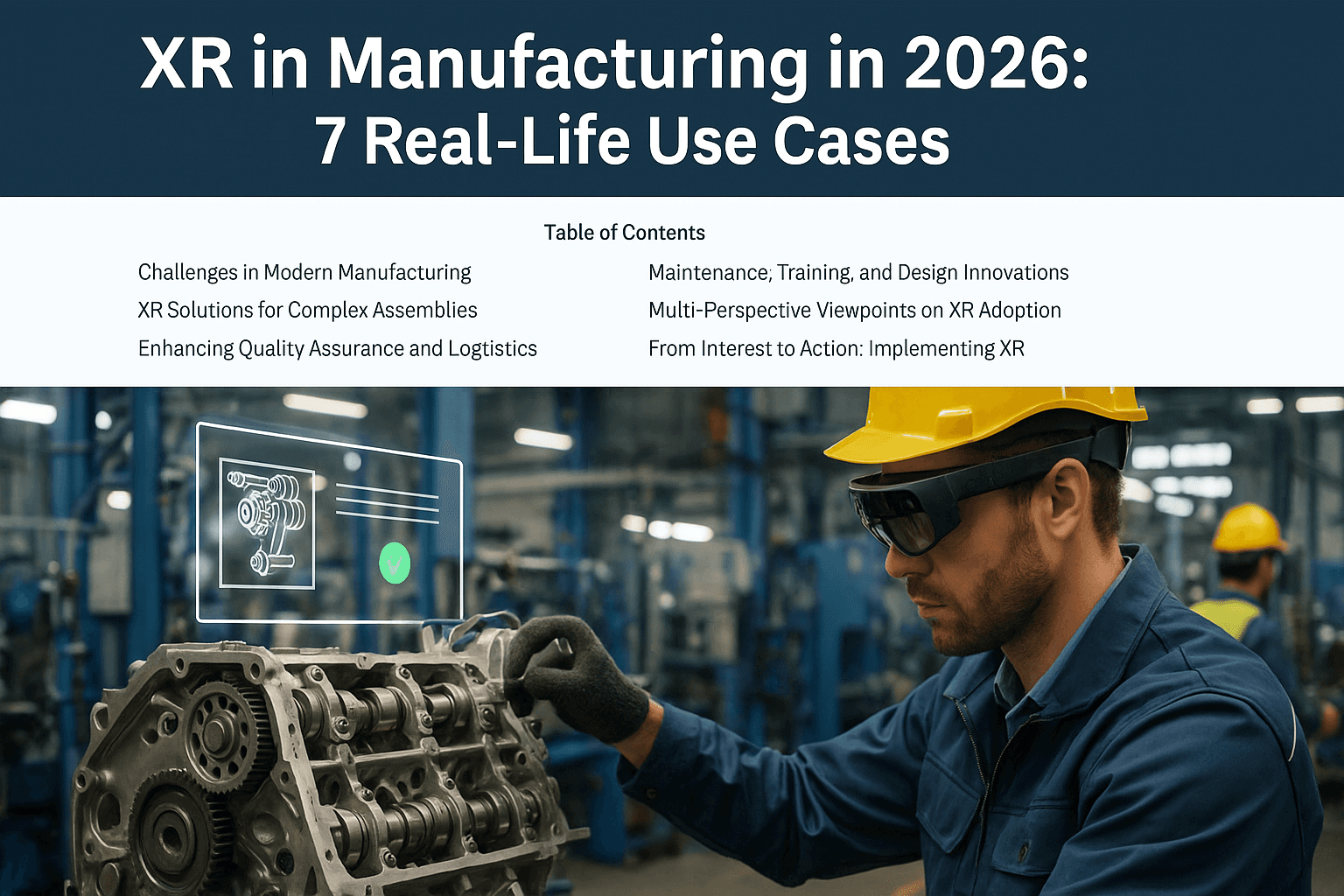
Imagine stepping into a factory where workers assemble complex machinery with pinpoint accuracy, guided by digital overlays that make errors a thing of the past. In 2026, extended reality (XR) technologies are not just futuristic dreams—they're driving tangible improvements in manufacturing, enhancing efficiency, safety, and collaboration. A recent article on XR/AR in Manufacturing in 2026: 7 Real-Life Use Cases highlights how AR and VR are being applied to real-world scenarios, from complex assemblies to quality assurance. For instance, companies like Airbus are using AR glasses to overlay visual instructions, reducing assembly times and minimizing mistakes. This isn't isolated; market analyses project the XR sector to reach USD 10.64 billion in 2026, growing at a staggering 40.95% CAGR, as detailed in the Extended Reality (XR) Market Size & Share Analysis. These advancements demonstrate XR's role in improving human life by creating safer work environments—reducing workplace injuries that account for 20% of incidents in high-risk manufacturing jobs—and fostering knowledge retention rates up to 70%. But how exactly do these technologies connect teams through shared interests and support public environment systems? This post dives into the problems XR solves, multi-perspective insights from industry leaders, and actionable steps for adoption. We'll explore benefits like streamlined logistics and immersive training, teasing how XR builds collaborative ecosystems that enhance productivity and worker well-being. By the end, you'll see why XR is a game-changer for modern manufacturing.
Table of Contents
Challenges in Modern Manufacturing
Manufacturing in 2026 faces persistent hurdles like complex assemblies that demand high precision, leading to errors and downtime. Workers often grapple with intricate machinery, where a single mistake can halt production lines and inflate costs. Safety remains a critical issue, with 20% of UK workplace injuries occurring in manufacturing, despite it comprising only 10% of the workforce. Traditional training methods fall short, resulting in knowledge retention rates as low as 30% for on-the-job skills. Logistics and quality assurance add layers of complexity, with manual processes prone to inefficiencies and inconsistencies. These challenges not only affect productivity but also worker morale, as repetitive tasks increase cognitive load and fatigue.
Moreover, global supply chains require seamless collaboration, yet remote support systems are often inadequate, leading to delays in maintenance and repairs. The rise of customization demands faster design iterations, but physical prototyping is time-consuming and resource-intensive. In public environment support systems, such as shared factory floors, there's a need for tools that foster connectivity without disrupting workflows. XR emerges as a beacon, addressing these by overlaying digital aids in real-time, but understanding the problems first sets the stage for appreciating its transformative potential.
XR Solutions for Complex Assemblies
Transitioning from challenges, XR provides insightful solutions for complex assemblies by simulating environments and offering guided instructions. For example, AR glasses overlay step-by-step visuals directly onto physical components, reducing errors by up to 50% in high-stakes tasks. This insight from real-world applications shows how XR studios are innovating to make assembly intuitive. The solution lies in immersive simulations that allow workers to practice without risking actual equipment, enhancing accuracy and speed.
Companies are leveraging this to connect teams through shared virtual models, aligning with interests in efficient collaboration. In practice, this means remote experts can join sessions via mixed reality, providing real-time input. Benefits include shorter assembly times and lower material waste, directly improving operational efficiency. As per industry reports, such integrations are projected to boost productivity by 15-25% in related sectors.
"Virtual reality solutions can be used to simulate complex assembly scenarios, allowing workers to practice in a safe and efficient manner," notes the use case analysis.
Enhancing Quality Assurance and Logistics
Quality assurance in manufacturing often suffers from human error in inspections, but XR overlays digital checklists and defect highlights for precision. This problem-to-solution flow sees AR tools like step-by-step visual aids reducing faults and capturing data automatically. Insights from 2026 applications reveal consistency improvements, with remote expert assistance minimizing downtime. The result? Higher standards and efficiency, as seen in examples where inspection times drop significantly.
In logistics, AR enables hands-free navigation and inventory management, addressing inefficiencies in asset tracking. By integrating with public environment support systems, XR fosters shared digital spaces for team coordination. Stats indicate productivity gains of 15-25% in order picking, with better accuracy and faster onboarding. These advancements connect workers through shared interests in streamlined workflows, ultimately enhancing safety and job satisfaction.
| Use Case | Benefit | Stat |
|---|---|---|
| Quality Assurance | Reduced Errors | Up to 50% fewer defects |
| Logistics | Increased Productivity | 15-25% improvement |
Maintenance, Training, and Design Innovations
Maintenance issues cause costly downtimes, but XR's overlaid diagrams and real-time guidance offer a direct solution. From problem identification to repair, AR standardizes procedures and enables knowledge transfer, cutting travel costs and errors. Training evolves with immersive VR simulations, solving low retention by providing risk-free practice and boosting engagement to 70% knowledge retention.
Design processes benefit from 3D prototyping in XR, allowing rapid iterations without physical models. This connects designers through shared virtual interests, accelerating development. Multi-perspective views highlight how these tools support public environments by enabling borderless collaboration, reducing time and resources while improving product quality.
- Faster repairs with first-time fix rates increasing.
- Immersive training reduces injury risks.
- Collaborative design saves on prototyping costs.
Multi-Perspective Viewpoints on XR Adoption
From a worker's viewpoint, XR alleviates cognitive load through intuitive guidance, fostering interest in tech-driven roles. Managers see it as a tool for efficiency, with stats showing 40% growth in XR shipments by 2025 leading into 2026. Industry experts emphasize safety benefits, quoting reduced injuries in high-risk areas.
Technologists highlight AI integration for anomaly detection, while executives focus on ROI from productivity gains. In public support systems, XR connects diverse teams via shared virtual spaces, aligning interests in innovation. These perspectives underscore XR's role in human-centric improvements, from individual well-being to organizational success.
From Interest to Action: Implementing XR
Sparking interest, XR's real-world wins in manufacturing invite action. Start by assessing needs—identify pain points like assembly errors. Pilot AR tools for targeted use cases, training teams on integration. Scale by connecting through shared interests, building support systems in public environments for collaboration.
Measure success with metrics like reduced downtime and improved retention. Partner with XR providers for customized solutions, ensuring seamless adoption. This progression from curiosity to implementation positions manufacturers for 2026 competitiveness, enhancing lives through safer, more engaging work.
- Assess and pilot XR applications.
- Train and integrate teams.
- Scale and measure impacts.
In synthesizing the transformative power of XR in 2026 manufacturing, it's clear these technologies are more than tools—they're enablers of human potential. From tackling complex assemblies to revolutionizing training, XR addresses core challenges, boosting efficiency by 15-25% and safety by curbing injuries. The multi-perspective insights reveal a consensus: XR fosters connections through shared virtual interests, creating public environment support systems that enhance collaboration and knowledge sharing. Market growth projections, like the XR sector reaching USD 10.64 billion, underscore its viability. As we've seen in real-world cases, such as AR-guided logistics and immersive designs, these innovations reduce cognitive load, accelerate processes, and improve worker satisfaction. Ultimately, XR demonstrates how immersive tech elevates human life by making work safer, more efficient, and interconnected. If you're in manufacturing, consider exploring XR pilots to stay ahead—visit resources like the XR/AR use cases article or market analysis for deeper dives. What's stopping you from integrating XR today? Take the first step toward a more immersive future.
Key Takeaways
- XR enhances manufacturing efficiency with AR overlays, reducing errors in assemblies and quality checks.
- Safety improves, addressing 20% of workplace injuries through immersive, risk-free training.
- Productivity boosts like 15-25% in logistics connect teams via shared virtual interests.
- Market growth at 40.95% CAGR signals widespread adoption by 2026.
- Multi-perspective benefits include better collaboration in public support systems.
- Actionable steps: Assess needs, pilot tools, and scale for ROI.
- XR fosters knowledge retention up to 70%, improving worker well-being.
- Integrate AI for real-time guidance, elevating human-centric innovations.
What are your thoughts? Comment below!
Generated by AI. Reviewed by Human.