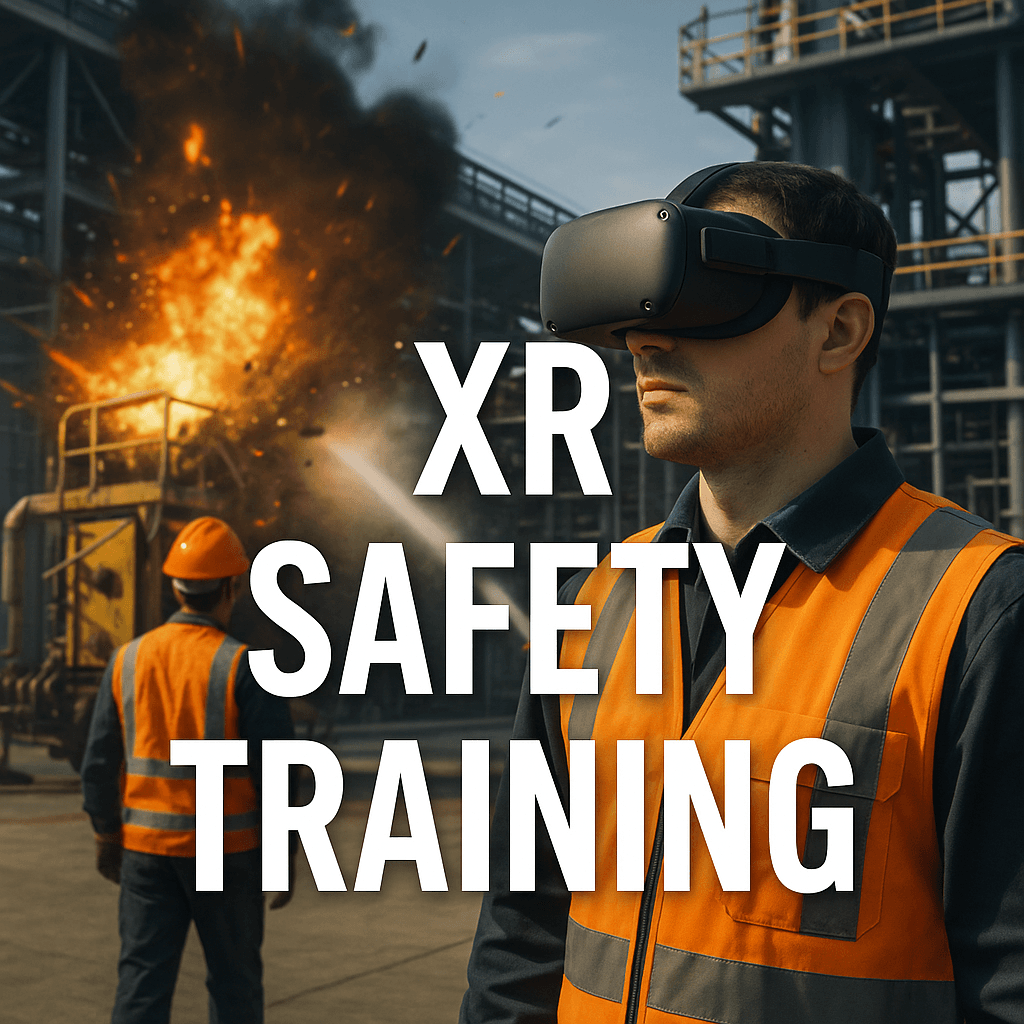
In a world where high-risk industries face constant threats from accidents and operational failures, imagine transforming routine safety training into immersive, life-saving experiences. This vision is becoming reality, as highlighted by the recent recognition of MetaNeural as a finalist in the Laval Virtual Awards 2026 for Developer & Authoring Tools. MetaNeural's AI-driven XR platform enables subject-matter experts to create complex simulations using natural language, without coding, focusing on high-risk sectors like semiconductors, oil & gas, and aerospace. For instance, it allows training for scenarios such as industrial accidents, equipment failures, and drone swarm attacks through interactive environments powered by multi-agent AI and real-world physics. This innovation not only enhances operational readiness but also integrates XR seamlessly into day-to-day activities, making safety protocols more engaging and effective. By drawing from MetaNeural's platform, we can explore broader XR insights that address everyday challenges in training and risk management. This article delves into the problems of traditional training methods, uncovers XR's transformative insights, proposes practical solutions for integration, and ends with a call to action for adopting these technologies. Expect takeaways on how XR can mitigate risks by up to 98%, foster proactive hazard prevention, and revolutionize daily workflows in critical industries.
Table of Contents
The Challenge of Traditional Safety Training
Traditional safety training in high-risk industries often relies on outdated methods like lectures, videos, and static simulations, which fail to capture the complexity of real-world hazards. Workers in sectors such as oil & gas or semiconductors frequently encounter unpredictable scenarios, yet these trainings lack interactivity, leading to low retention rates and inadequate preparation. For example, a worker might memorize protocols for an equipment failure but struggle to apply them under stress. This disconnect results in higher accident rates, costly downtime, and even loss of life. According to industry reports, inadequate training contributes to over 70% of workplace incidents in manufacturing. The problem intensifies with the need for rapid knowledge transfer in dynamic environments, where lengthy training cycles delay readiness. Moreover, traditional approaches do not adapt to individual learning styles, making them inefficient for diverse teams. Integrating XR could address these gaps by providing immersive, hands-on experiences that mimic real threats without actual risk.
XR Insights from MetaNeural Innovations
MetaNeural's platform offers profound insights into how XR can elevate daily safety practices beyond conventional limits. By leveraging AI to generate no-code simulations, it allows experts to build tailored scenarios for threats like explosions or system failures, as detailed on their solutions page. This approach reveals that XR isn't just about immersion; it's about creating mission-critical tools for proactive risk mitigation. In high-risk industries, the platform's real-time physics and multi-agent AI enable users to explore infinite safety solutions, fostering a deeper understanding of hazards. A key insight is the shift from reactive to preventive training, where workers can practice responses in virtual environments that feel authentic. This integration highlights XR's potential in day-to-day activities, such as routine drills becoming dynamic sessions that improve decision-making. Furthermore, the recognition at the Laval Virtual Awards 2026 underscores its innovation in developer tools, paving the way for broader XR adoption. Ultimately, these insights demonstrate XR's role in enhancing operational resilience through everyday applications.
Solutions for Integrating XR into Daily Activities
To integrate XR into day-to-day activities, start by adopting platforms like MetaNeural's, which enable seamless creation of custom training modules. One practical solution is to incorporate XR into morning safety briefings, where teams use VR headsets for quick hazard simulations before shifts. This can be supported by no-code tools that allow supervisors to update scenarios based on recent incidents, ensuring relevance. In aerospace, for instance, daily XR sessions could simulate equipment checks, reducing errors by providing haptic feedback and real-time analytics. Another approach involves hybrid training programs that blend XR with physical drills, gradually building muscle memory. Organizations can leverage MetaNeural's vision for AI-driven adaptability, tailoring experiences to individual performance data. To scale, invest in affordable XR hardware and cloud-based platforms for remote access. Finally, measure success through metrics like reduced incident rates and improved retention, adjusting integrations based on feedback.
- Implement daily XR micro-sessions for hazard recognition.
- Use AI to personalize training paths.
- Integrate with existing workflows for minimal disruption.
- Track progress with built-in analytics.
Overcoming Barriers to XR Adoption
Despite its promise, adopting XR faces barriers like high initial costs and technical complexity, but solutions exist to mitigate these. Begin by selecting user-friendly platforms such as MetaNeural, which require no coding, as emphasized on their company profile. To address cost, opt for scalable SaaS models that allow pay-per-use, reducing upfront investments. Training staff on XR can be streamlined through guided tutorials embedded in the platform itself. Resistance from employees accustomed to traditional methods can be overcome by demonstrating quick wins, like shorter training times and engaging experiences. Infrastructure challenges, such as limited device availability, can be solved by starting with pilot programs in key departments. Regulatory hurdles in industries like oil & gas require compliance-focused XR designs that align with safety standards. By partnering with innovators like MetaNeural, companies can navigate these barriers, ensuring XR becomes a staple in daily operations.
Future Implications of XR in Everyday Life
Looking ahead, XR's integration into daily activities could extend beyond industries to personal safety and education, inspired by advancements like MetaNeural's. Imagine homeowners using XR apps for emergency preparedness, simulating fires or natural disasters in their living spaces. In education, students could engage in virtual lab experiments, making learning interactive and risk-free. This evolution points to a future where XR blurs lines between work and life, enhancing overall resilience. However, ethical considerations, such as data privacy in AI simulations, must be addressed to build trust. As technology advances, expect more accessible devices, democratizing XR for small businesses and individuals. The ripple effects could include lower global accident rates and innovative urban planning through virtual modeling. Embracing these implications requires ongoing innovation, positioning XR as an essential tool for a safer, more efficient world.
Synthesizing the insights from MetaNeural's groundbreaking work, it's clear that XR is not merely a futuristic concept but a practical enhancer of everyday safety and efficiency. By addressing the shortcomings of traditional training through immersive, AI-powered simulations, platforms like this are setting new standards in high-risk industries. The broader implications extend to fostering a culture of proactive prevention, where daily activities incorporate virtual rehearsals to minimize real-world risks. This shift could significantly reduce workplace incidents, boost productivity, and even influence non-industrial sectors like healthcare and education. As we've explored, the journey from problem identification to XR-driven solutions reveals untapped potential for integration, overcoming barriers through scalable, user-friendly tools. Ultimately, supporting innovations like MetaNeural encourages a safer future—consider exploring their platform to see how it can transform your operations. Whether you're in aerospace or manufacturing, now is the time to integrate XR into your routines for lasting impact. Let's champion these advancements to build resilient communities and industries worldwide.
Key Takeaways
- MetaNeural's XR platform enables no-code creation of hazard simulations for high-risk industries.
- Traditional training methods often fail due to lack of interactivity, leading to higher accident rates.
- XR insights emphasize proactive risk mitigation through real-time, AI-driven environments.
- Practical solutions include daily XR sessions and hybrid programs for seamless integration.
- Overcoming adoption barriers involves scalable SaaS models and pilot programs.
- Future XR applications could extend to personal safety and education beyond industries.
- Supporting XR innovations like MetaNeural can reduce risks by up to 98%.
- Embrace XR for enhanced operational readiness and everyday efficiency.
What are your thoughts? Comment below!
Generated by AI. Reviewed by Human.