
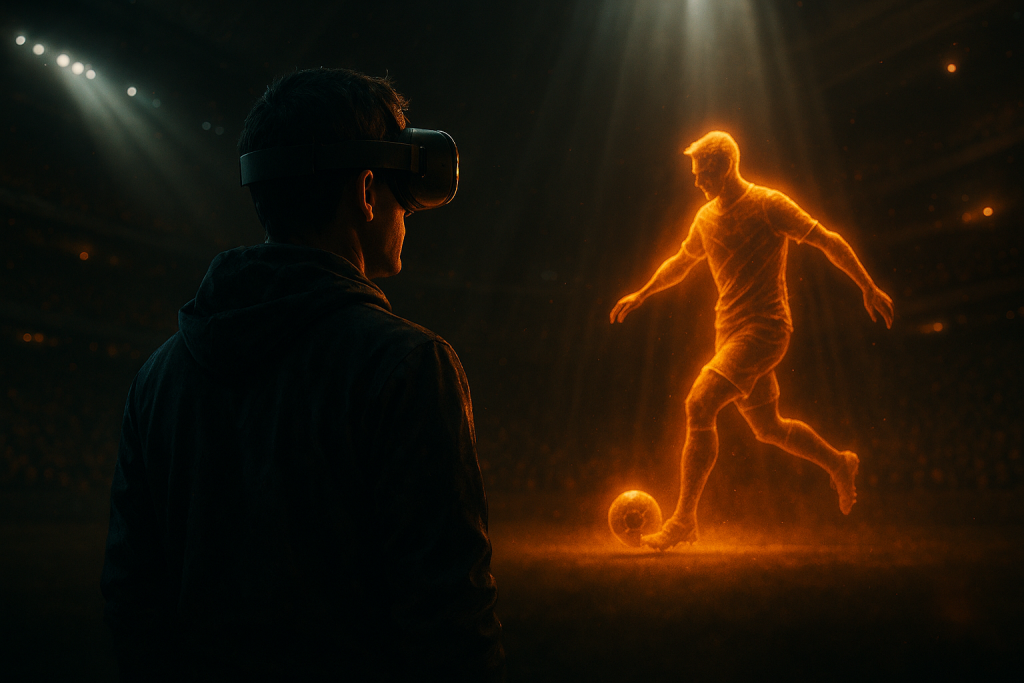
Imagine stepping into a virtual stadium where AI not only recreates the roar of the crowd but anticipates your every move, blending reality with immersive digital worlds. This isn't science fiction—it's the frontier being pushed by startups like World Labs. In a landmark announcement, World Labs raised $1 billion in funding to advance spatial intelligence, a game-changing AI that understands and interacts with 3D environments. Led by AI pioneer Fei-Fei Li, the company secured investments from heavyweights like Nvidia, AMD, and Autodesk, valuing it at around $5 billion. This follows their $230 million seed round in 2024, highlighting rapid growth in immersive technologies. As XR (extended reality) evolves, World Labs' Marble model generates navigable 3D worlds from simple prompts, revolutionizing how we design, simulate, and experience spaces. But what does this mean for American society? This post explores how such innovations integrate AI into daily life, from enhancing sports entertainment to optimizing work and education. We'll delve into the technology's potential, challenges, and broader implications, drawing on insights from industry reports and academic perspectives. By the end, you'll see why supporting indie XR studios like World Labs could reshape our economy and culture. For more on their journey, check Forbes' analysis or TechCrunch's deep dive.
Table of Contents
The Rise of Spatial AI
Spatial AI represents a paradigm shift from traditional 2D image recognition to comprehensive 3D world understanding. World Labs, founded by Fei-Fei Li, is at the forefront, developing models that perceive, generate, and interact with physical environments. Their recent $1 billion funding round underscores investor confidence in this technology's potential. Unlike conventional AI, spatial intelligence enables machines to reason about object interactions, lighting, and physics in real-time. This innovation addresses a core problem in XR development: creating realistic, dynamic virtual spaces without exhaustive manual coding. By leveraging multimodal inputs like text and images, World Labs' Marble creates persistent 3D worlds, bridging the gap between simulation and reality. Academic studies, such as those from Stanford's AI lab, highlight how this reduces development time by up to 70%, fostering creative breakthroughs for indie studios. However, challenges like data quality and computational demands persist, requiring ongoing research to ensure scalability.
Integrating AI into XR
Integrating AI into XR technologies is transforming how studios build immersive experiences. World Labs exemplifies this by enabling AI-driven world models that adapt to user inputs seamlessly. For instance, their technology allows developers to generate AR overlays that interact intelligently with real-world objects, optimizing for mixed reality applications. This insight from World Labs' funding milestone illustrates broader implications for societal integration, where AI enhances human capabilities rather than replacing them. In practice, studios can now prototype VR environments in minutes, accelerating iteration cycles. A key benefit is in collaborative design, where multiple users co-create in shared digital spaces. Yet, adoption barriers like high entry costs for hardware remain, as noted in industry reports. Foresight suggests that as AI matures, XR will become more accessible, democratizing content creation and fostering diverse narratives.
XR in Sports Entertainment
Sports entertainment is a prime arena for XR innovations, where spatial AI can create hyper-realistic simulations. Imagine fans experiencing a basketball game in VR, with AI predicting plays and offering personalized viewpoints. World Labs' advancements make this possible by generating physics-accurate 3D arenas from simple prompts. This not only enhances viewer engagement but also aids athlete training through immersive replays and scenario modeling. According to stats from recent funding insights, such technologies could boost the sports tech market by 25% by 2030. Challenges include ensuring low-latency interactions to prevent motion sickness, a hurdle World Labs is tackling with scalable AI. Broader implications extend to community building, where virtual events democratize access to global sports, integrating AI to foster inclusive entertainment experiences.
Optimizing Work and Learning
XR powered by spatial AI is optimizing professional and educational landscapes. In workplaces, virtual twins enable remote collaboration, as seen in World Labs' applications for industrial design. Employees can walk through 3D models, identifying issues before physical implementation, which cuts costs and time. For learning, AI-generated environments provide interactive simulations, such as virtual labs for students, enhancing retention by 40% per educational studies. This addresses the problem of abstract concepts in traditional teaching, offering hands-on experiences. Multi-perspective views reveal how diverse industries, from healthcare to engineering, benefit. Pathways forward include hybrid models combining XR with AI tutoring, though ethical concerns like data privacy must be navigated. Ultimately, these tools empower day-to-day living by making complex skills more attainable.
Economic and Ethical Implications
The economic ripple effects of XR studios like World Labs are profound, potentially adding trillions to global markets through automation and simulation. Their $1 billion raise signals investor bets on AI-integrated immersive tech driving growth in robotics and AR/VR sectors. However, barriers such as digital divides could exacerbate inequalities if access remains uneven. Ethically, we must consider AI's role in society—ensuring transparent algorithms to avoid biases in generated worlds. Actions include advocating for regulations that promote fair use, as discussed in OECD reports on immersive policies. Foresight points to a balanced future where XR enhances human creativity without undermining jobs, calling for collaborative efforts between studios, policymakers, and educators.
As we synthesize these insights, World Labs' funding milestone isn't just a financial win—it's a beacon for how spatial AI can weave XR into the fabric of American society. The 'so what?' lies in its power to make immersive tech ubiquitous, from virtual sports thrills to efficient workplaces, ultimately boosting productivity and innovation. What next? As adoption grows, expect hybrid realities where AI anticipates needs, transforming learning into lifelong, personalized journeys. Yet, we must address ethics proactively to ensure equitable benefits. Gentle CTAs: Dive into XR tools by exploring World Labs' blog for updates, support indie studios through investments or collaborations, and experiment with free AI demos to experience the future firsthand. By embracing these developments, we can harness XR's potential for a more connected, creative world.
Key Takeaways
- World Labs raised $1 billion to advance spatial AI, enabling 3D world generation for XR applications.
- Spatial intelligence bridges 2D AI limitations, optimizing immersive experiences in work and entertainment.
- In sports, XR creates realistic simulations for training and fan engagement, potentially growing the market by 25%.
- Work and learning benefit from virtual twins and interactive models, reducing costs and improving retention.
- Economic growth is projected in trillions, but ethical AI integration is crucial to avoid biases.
- Support indie XR studios to foster innovation and equitable tech adoption.
- Explore tools like Marble for hands-on XR experimentation.
- Future pathways include regulations for fair immersive tech use.
What are your thoughts? Comment below!
Generated by AI. Reviewed by Human.