Navigating the Unseen: How XR Technology Could Revolutionize Travel in Fog and Blizzards
Hypothetical Situation
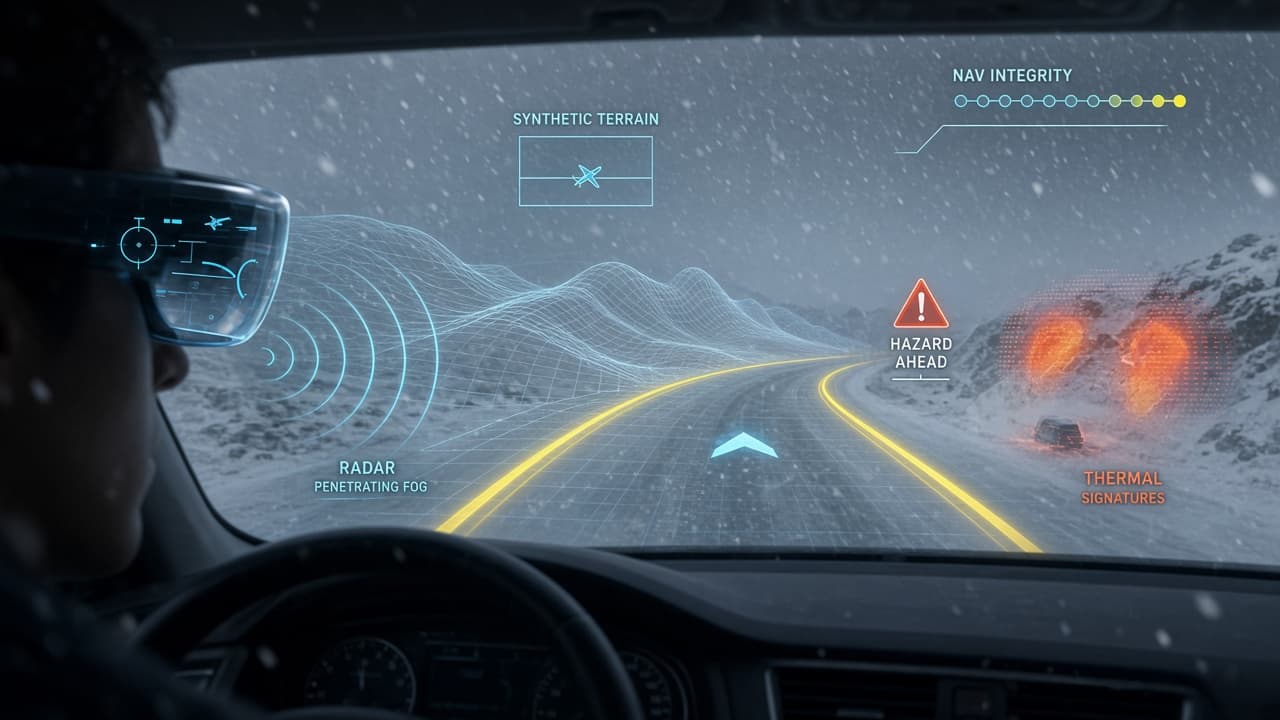
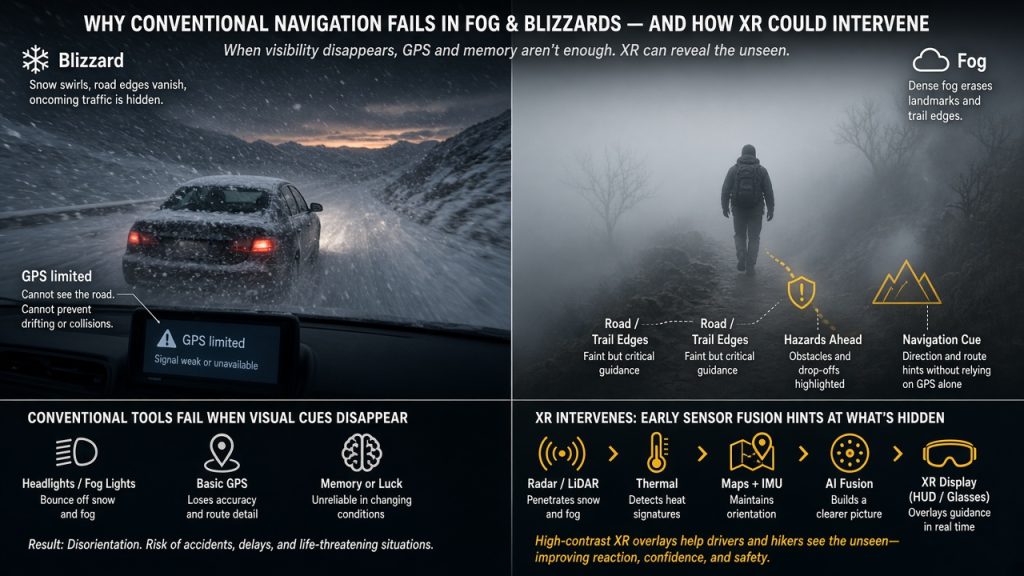
Imagine driving a remote mountain road at dusk as a sudden blizzard hits. Visibility drops to near zero—snow swirls, landmarks vanish, and GPS alone cannot prevent drifting into a ditch or oncoming traffic. Or picture a hiker caught in dense fog on a trail, disoriented with no clear path forward. These scenarios are all too common in adverse weather, contributing to accidents, delays, and life-threatening situations. Traditional tools like headlights, fog lights, or basic GPS falter when visual cues disappear, leaving users reliant on memory or luck.
The XR Solution
Extended Reality (XR)—encompassing augmented reality (AR) overlays, mixed reality (MR), and supporting sensors—offers a transformative approach. While no widely available consumer product today fully addresses everyday ground navigation in fog or blizzards (searches reveal primarily research prototypes, aviation/military systems, and conceptual AR head-up displays or HUDs), this represents a high-potential XR capability ready for development.
Existing foundations include:
- Research on AR-HUDs for vehicles that use deep learning, radar, thermal imaging, and LiDAR to highlight obscured lanes, obstacles, and navigation cues in real time (e.g., studies showing reduced reaction times and lane departures in simulated fog/rain).
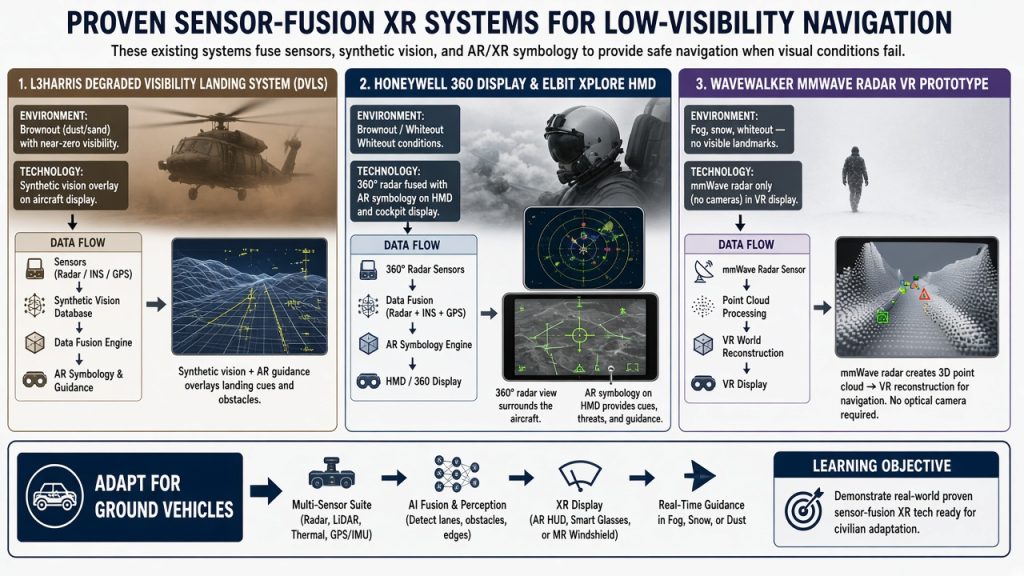
- Aviation and military systems like L3Harris Degraded Visibility Landing System (DVLS), Honeywell 360 Display, Elbit Xplore radar-integrated HMDs, and Universal Avionics ClearVision EFVS, which fuse synthetic vision, sensor data, and AR symbology for pilots in brownout/whiteout conditions.
- Prototypes such as mmWave radar-enhanced VR systems (e.g., WaveWalker) that function in low-visibility without relying on cameras.
A proposed consumer XR solution could be lightweight AR glasses or a vehicle-integrated HUD/MR windshield that overlays:
- Synthetic terrain, road edges, and obstacles detected via multi-sensor fusion (radar/LiDAR for penetration through snow/fog, thermal for heat signatures, GPS/IMU for positioning, and pre-loaded maps).
- Dynamic navigation arrows, lane highlights, hazard warnings, and distance cues aligned with the real world.
- Optional full synthetic vision mode for near-zero visibility.
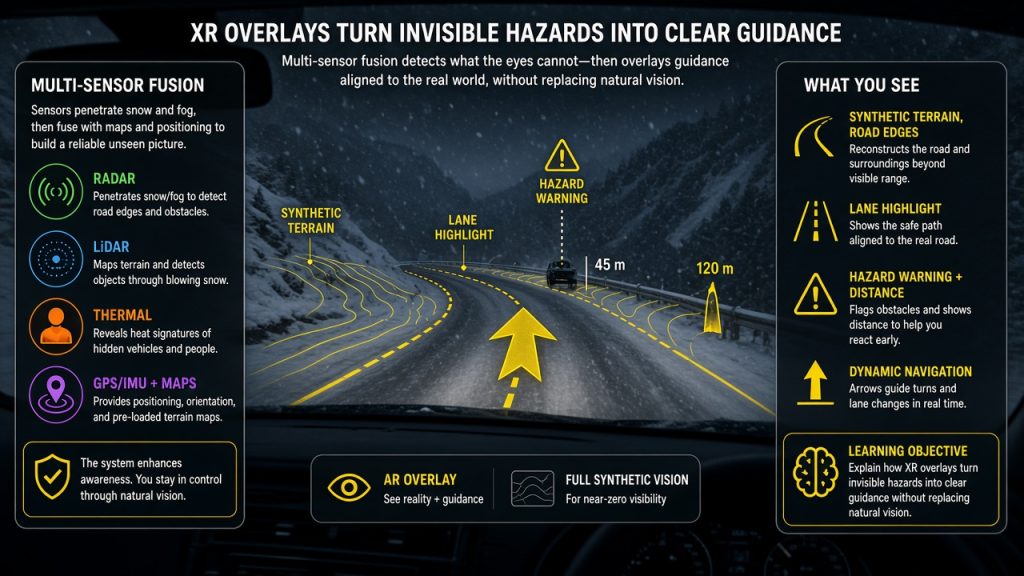
This would enhance situational awareness without replacing natural vision, drawing from proven aviation tech while adapting it for cars, off-road vehicles, or wearables. Benefits include faster reactions, fewer accidents, and greater confidence in harsh conditions.
Steps to Implement the XR Solution
1. Sensor and Hardware Integration: Combine compact, weather-resistant sensors (e.g., automotive-grade radar, LiDAR, thermal cameras, and IMUs) with XR displays (AR glasses like advanced versions of existing headsets or vehicle HUDs). Ensure low latency (<50ms) and ruggedization for outdoor use.
2. AI-Powered Perception and Fusion: Develop or adapt deep learning models for real-time object/terrain detection, lane prediction, and sensor reliability assessment (handling domain shifts from snow/fog). Fuse data with maps for predictive overlays.
3. XR Overlay Design: Create intuitive AR/MR interfaces with high-contrast elements (e.g., yellow or contour-enhanced icons per research on extreme weather HUDs), dynamic saliency to reduce inattentional blindness, and user calibration for eye/head tracking.
4. Software and Mapping Platform: Build an app/ecosystem that pulls real-time weather data, updates maps, and supports offline operation. Include simulation tools (VR-based) for training and validation.
5. Testing and Iteration: Conduct controlled simulations (fog chambers, winter test tracks) followed by real-world trials. Address challenges like sensor occlusion in heavy snow via redundancy and AI filtering. Partner with automakers or XR hardware firms for integration.
6. Regulatory and Safety Compliance: Meet standards for automotive/aviation displays, ensure fail-safes (e.g., fallback to audio alerts), and validate reduced cognitive load.
Prototypes could leverage open research (e.g., AR-HUD studies) and adapt military systems for civilian use, with timelines of 2–5 years for viable products depending on investment.
Call to Action
XR developers, automakers, and sensor companies: Prioritize this capability—fund pilots, collaborate on standards, and bring multi-sensor AR navigation to market. Researchers: Expand on existing AR-HUD and synthetic vision work for ground applications. Consumers and policymakers: Advocate for weather-resilient tech in vehicles and trails; support funding for low-visibility safety innovations. Early adopters can test beta versions or simulators to shape the future.
Closing Remarks
Fog and blizzards need not remain barriers to safe travel. By extending proven XR principles from aviation into everyday use, we can turn invisible hazards into clear, actionable guidance—saving lives, reducing stress, and unlocking new mobility in challenging environments. The technology exists in pieces; assembling them into accessible XR solutions is the next frontier. As weather patterns grow more unpredictable, this capability isn't just innovative—it's essential.