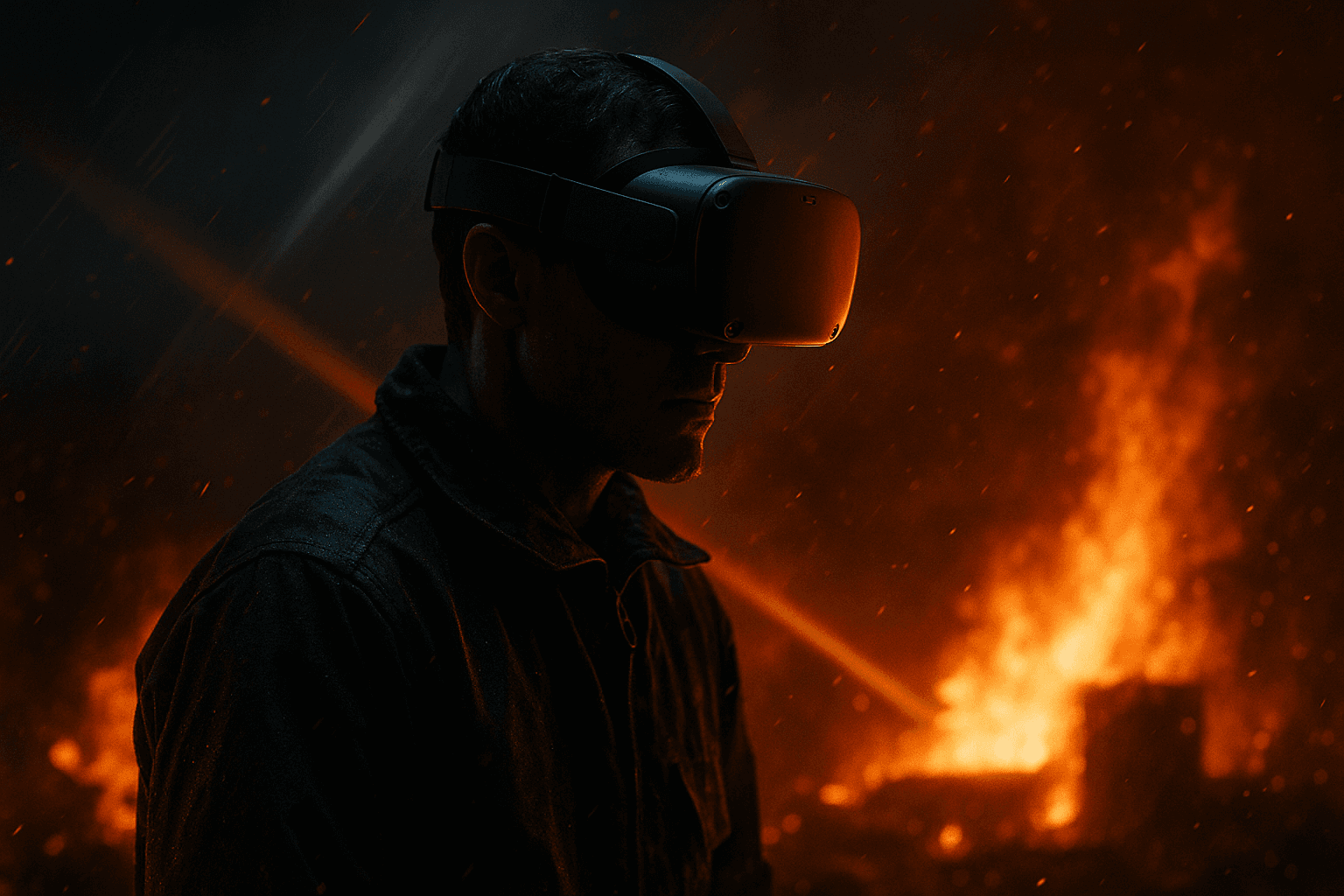
Public safety agencies increasingly consider extended reality (XR) systems—virtual, augmented, or mixed reality—for training in high-stakes scenarios such as mass-casualty incidents, firefighting, and police de-escalation. A 2024 systematic review of 18 studies found XR improved triage accuracy, speed, and performance correctness among medical first responders compared with standard approaches, and participants rated the systems useful and engaging. Yet a separate 2024 review of resuscitation training found augmented reality helped only when providing real-time feedback, while virtual reality often matched or underperformed other instructional methods. The gap between promising lab results and routine operational use remains wide for departments weighing purchase decisions this year.
Strongest evidence supports short-term skill gains in repeatable scenarios
The 2024 mass-casualty review synthesized data across virtual, mixed, and augmented reality interventions. Triage accuracy rose and task times fell in most included trials; knowledge retention and participant satisfaction were consistently high. Studies spanned paramedics, nurses, and physicians in eight countries, with pre-post or controlled designs. A 2025 systematic review of virtual reality for firefighting training identified benefits in search-and-rescue and incident-command scenarios, particularly when systems incorporated biofeedback or stress measures. These findings rest on experimental comparisons rather than long-term field outcomes.
Resuscitation and police applications show narrower or inconsistent advantages
In resuscitation training, augmented reality delivered measurable CPR quality improvements only versus no-feedback controls; it performed similarly to other feedback tools. Virtual reality studies more often showed no difference or favored conventional practice. A 2024 critical review of 41 publications on police XR training documented use in crisis and de-escalation simulations yet flagged limited validation of skill transfer and raised concerns about psychological impact and scenario fidelity. No large-scale, pre-registered trials demonstrate superior real-incident performance across domains.
Cost, technical, and integration barriers limit broad adoption
Market surveys and agency reports note high upfront hardware and software costs, plus ongoing needs for calibration, connectivity, and instructor training. A 2025 environmental scan of police services highlighted procurement delays, curriculum approval hurdles, and rapid obsolescence. Departments without dedicated simulation staff or IT support face steeper hurdles. Evidence for cost savings appears mainly in reduced need for live-exercise resources rather than direct budget comparisons.
XR works by allowing safe repetition of rare, high-risk events
Imagine rehearsing a multi-vehicle collision response on a Tuesday afternoon without blocking roads or exhausting mutual-aid partners. The headset places responders inside a consistent, controllable scene where mistakes carry no physical cost and the same scenario can run ten times in one shift. This repetition targets the precise decision points—triage sequencing, resource allocation, communication—that live drills can stage only a few times per year. The mechanism does not replace the stress or sensory detail of an actual event; it multiplies practice opportunities between those events.
Start with a single, low-cost pilot matched to existing training gaps
Option 1: Borrow or rent one consumer-grade headset and load a publicly available or low-cost MCI triage module; run it with one shift during a scheduled training block and compare pre- and post-scenario triage accuracy on a paper checklist. Option 2: Use free or open-source de-escalation scenarios for two officers per week, tracking time-to-appropriate verbal intervention. Option 3: Partner with a neighboring agency that already owns systems for a shared half-day session focused on one documented weakness, such as radio traffic during simulated incidents. All options fit within an afternoon and require no new personnel or capital outlay beyond possible rental fees under $500.
Common missteps include expecting full replacement of live training or ignoring transfer evidence
Agencies sometimes purchase full suites assuming automatic superiority; current data do not support that. Over-reliance on virtual environments can reduce exposure to physical stressors or equipment weight. Police-specific reviews note risks of psychological distress from highly realistic scenarios and questions about whether improved simulator scores predict street performance. Results may not generalize beyond the specific populations and short outcome windows studied.
Run a two-week pilot and stop if accuracy does not rise
Select one measurable task already part of your curriculum—triage tags placed correctly or time to first radio report. Have four to six responders complete the XR module once, then reassess the same task in a standard drill within 48 hours. Continue only if at least half the participants show a clear, sustained improvement on that metric after two sessions. Halt and revert to prior methods if no measurable gain appears or if technical friction exceeds one hour of setup per session.
Sources
Systematic reviews: “Extended reality training for mass casualty incidents” (Int J Emerg Med, 2024); “Use of augmented and virtual reality in resuscitation training” (Resuscitation Plus, 2024); “SYSTEMATIC REVIEW OF VIRTUAL REALITY TOOLS FOR FIREFIGHTING TRAINING” (2025). Single studies and reports carry design limits noted above. DHS SAVER market survey on VR training systems (2024) for product landscape only.