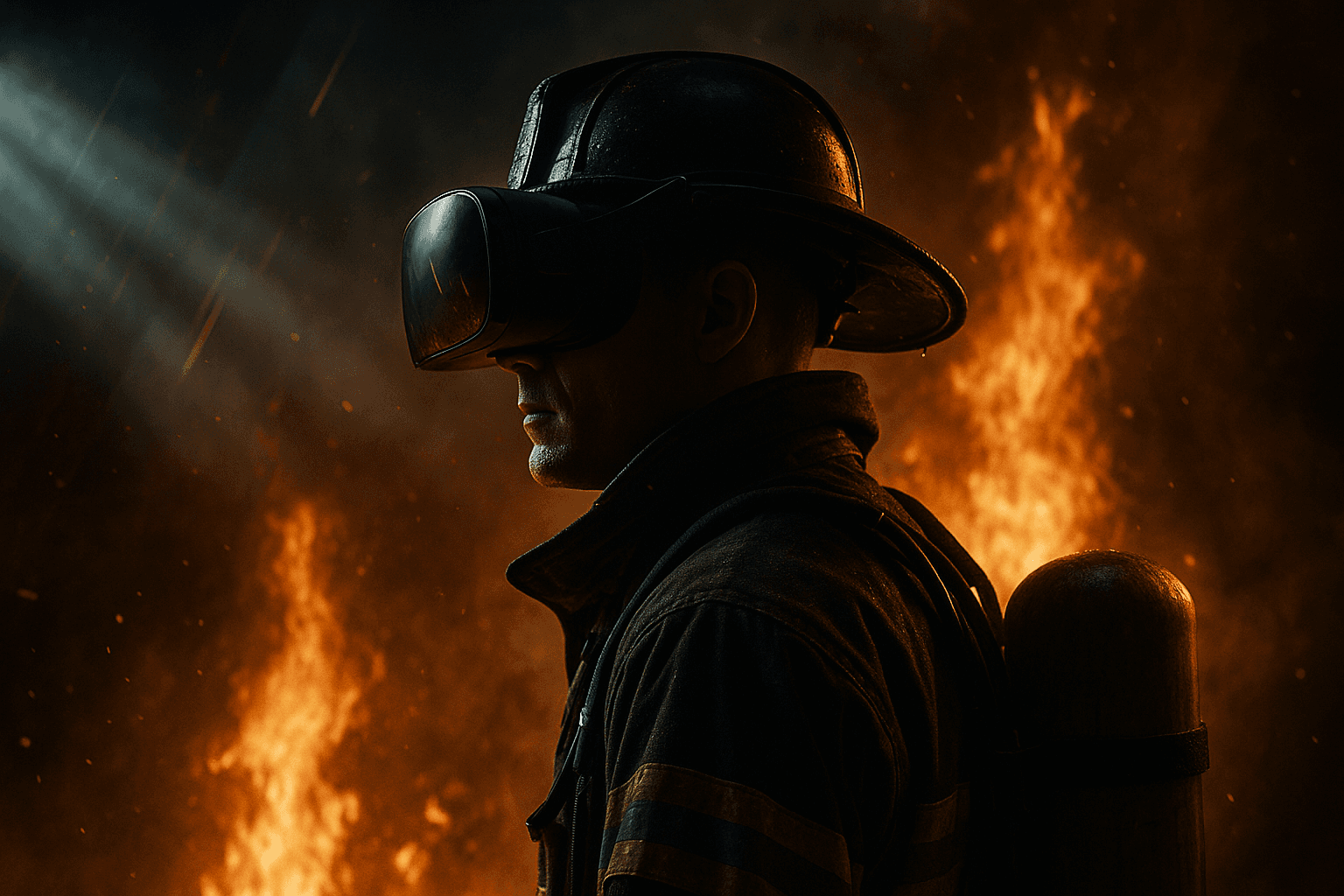
Public safety agencies increasingly explore extended reality—virtual, augmented, and mixed reality—for training firefighters, police, and emergency responders. Systematic reviews of studies through 2025 show these tools boost engagement and short-term performance in controlled scenarios, but high-quality evidence of better real-world outcomes stays limited. For an intelligent non-specialist with one afternoon, the practical step is learning enough to ask informed questions of local agencies rather than expecting consumer-grade solutions to replace drills.
Reviews document gains in engagement and simulated performance
Multiple scoping and systematic reviews covering dozens of studies find XR training increases user engagement, knowledge acquisition, and metrics such as triage accuracy or decision speed during simulations. One 2024 meta-analysis of augmented reality safety training across industries reported a significant positive impact on training outcomes. Similar patterns appear in reviews of police de-escalation, firefighter incident command, and mass-casualty medical response.
Evidence for skill transfer to actual incidents stays thin
Few studies track whether improvements seen in VR headsets appear on real calls or scenes. Critical reviews of police XR training note scarce data on transfer, with most evaluations relying on self-reports or lab-like measures. Concerns include psychological effects, simulator sickness, and the risk that immersive practice creates overconfidence without corresponding field gains.
Cost, validation, and standardization limit broader adoption
Technical complexity, hardware expense, and the absence of standardized protocols appear repeatedly as barriers. Forensic and crime-scene applications show promise for reconstruction and courtroom presentation, yet legal admissibility and accuracy validation require further work. Public-safety XR remains largely professional-grade rather than ready for individual or small-budget use.
Mechanism: controlled repetition without real risk
XR places trainees inside repeatable, adjustable scenarios that mimic high-stakes decisions—approaching an unknown person, managing a fire floor, or triaging casualties—while logging actions for immediate feedback. This mirrors flight-simulator logic: volume of practice rises because mistakes cost pixels, not lives, though the gap between headset and street remains the open variable.
Options scaled to limited time and budget
Watch free or low-cost demo videos of police or firefighter XR scenarios on agency or research sites to see typical setups. Contact a local fire or police training division by email or public-records request to ask what evidence they review before adopting XR tools. If a headset is already owned, sample publicly available safety or evacuation simulations; treat them as awareness tools only.
Common misreads and trade-offs
Lab improvements do not automatically equal field superiority; small samples and short follow-up periods weaken many claims. Over-reliance on any single technology can divert resources from proven low-tech drills. XR may suit repetitive decision practice better than physical-fitness or equipment-handling components of training.
First action this week and stop rule
Spend one afternoon locating and reading the abstract or open-access version of one recent systematic review on XR in emergency services training. Note the stated limitations. If the review’s uncertainties match what local agencies claim, stop there; otherwise request their internal evaluation data. Revisit when a new large-scale field study appears or when your agency publishes adoption metrics.
Sources
Systematic and scoping reviews: Gong et al. (Safety Science, 2024) on AR safety training meta-analysis; Sudhakaran et al. (Smart and Sustainable Built Environment, 2024) on XR for vulnerable road users; Podoletz et al. (2024) critical review of XR police training; multiple 2025 reviews on XR for first responders, EMS, and forensics appearing in IEEE, Springer, and PMC. Single studies cited only with design qualifiers in the source reviews.